
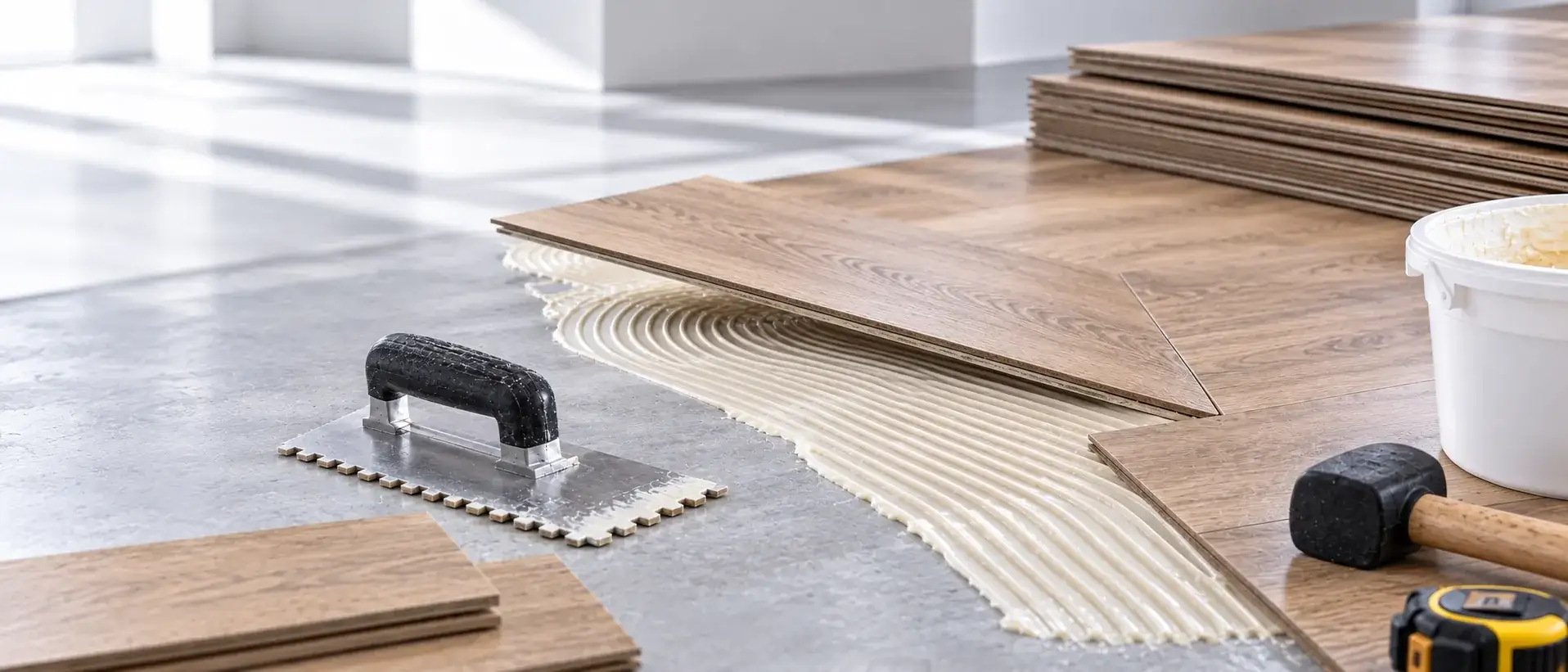
Water-Based Flooring & Installation Adhesives
Acrylic dispersion adhesives are the established route for installing resilient flooring and carpet tiles, and water-based adhesives also handle lighter interior mounting and wallpaper. They rely on an absorbent substrate or open time to lose their water, so the floor or wall they go on matters as much as the covering.
An application we assess on request. Share your substrates, process and target requirements and we will confirm suitability, available documentation and sourcing feasibility — no stock grade is listed yet.
Discuss Your Application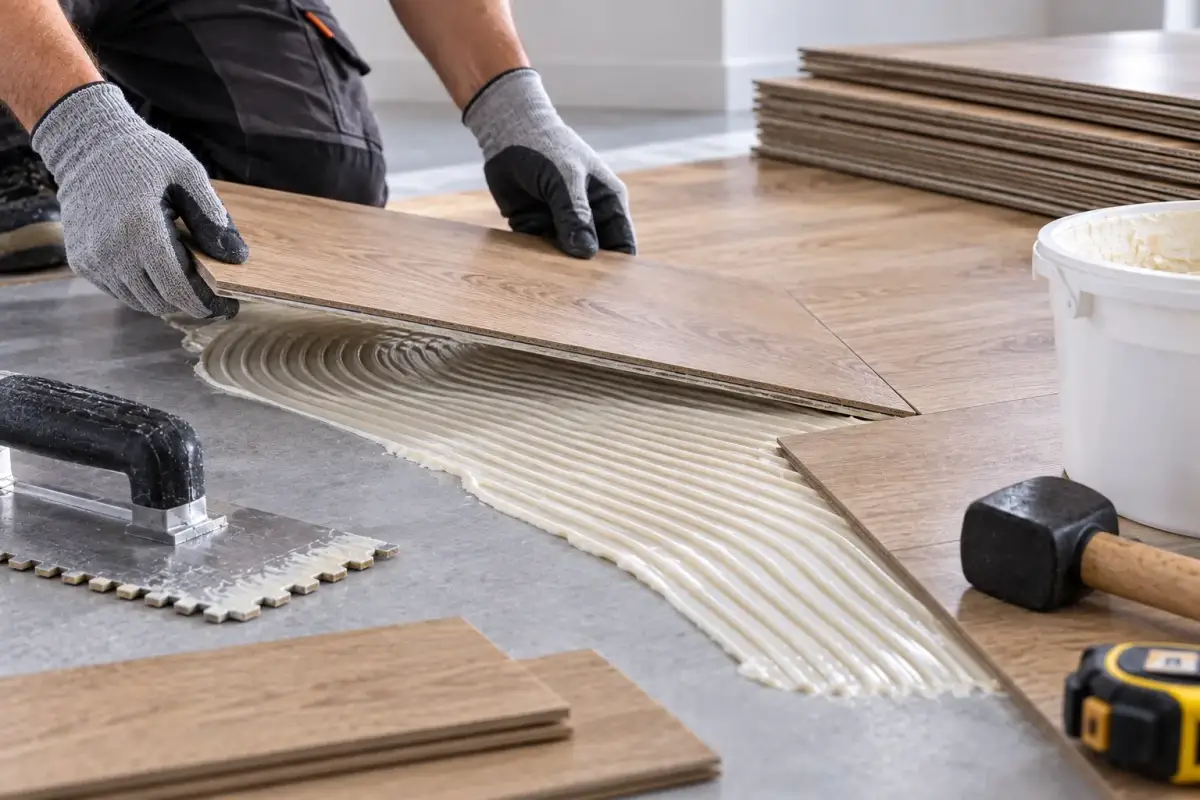
Resilient Flooring
Sheet vinyl, LVT, linoleum and rubber are not interchangeable for adhesive. Vinyls contain plasticisers that can migrate into and soften an incompatible adhesive; rubber and linoleum have their own requirements. Flooring manufacturers publish approved adhesives, and warranties usually depend on them.
Acrylic flooring adhesives are used either wet-set, laying the flooring into adhesive that is still wet, or pressure-sensitive, waiting until the adhesive has dried to a tacky film. The flooring maker specifies which, and the trowel notch sets how much adhesive goes down.
Carpet Tiles: Tackifiers Are Not Permanent Adhesives
Carpet tiles are usually held with a releasable tackifier: a thin film that stops tiles sliding but lets any tile be lifted and replaced. Broadloom carpet is often fully bonded with a permanent adhesive. The SBR latex on the back of a carpet is part of its manufacture, not an installation adhesive — see backing compounds.
Interior Mounting
Water-based acrylic mounting adhesives fix skirting, mouldings and light panels indoors, and many can be painted. At least one surface has to be absorbent — plaster, timber, MDF — so the water can leave. Heavy items, two non-absorbent surfaces, exterior work and wet areas need another adhesive; our construction adhesive page sets out which grade suits which job.
Wallpaper
Wallpaper adhesives are starch or methyl cellulose based, sold as powder to mix or ready to use. Heavy vinyl and non-woven papers need stronger formulations than lightweight paper, and adhesives for humid rooms often contain a mould inhibitor.
Substrate Moisture and Absorbency
Most resilient flooring failures start in the substrate. Moisture coming up through a concrete slab degrades adhesive and lifts flooring, so it is measured before installation — for example with in-situ relative humidity probes to ASTM F2170, or the calcium carbide (CM) method common in Europe — and compared with the limits the flooring and adhesive makers set. Non-absorbent surfaces such as old tiles or painted floors need a primer and levelling compound, or an adhesive designed for them. Room and substrate temperature at installation also have to be inside the adhesive’s range.
Emission Requirements
Interior projects often specify installation products by emission label — EMICODE EC1 or EC1 Plus, GREENGUARD, or a national scheme. These are chamber tests of named products, so a water-based adhesive does not meet them by being water-based. If your project names a label, tell us which, and see our VOC limits by market for content limits.
What to Tell Us
| Parameter | Why it matters | What to tell us |
|---|---|---|
| Floor or wall covering | Sheet vinyl, LVT, linoleum, rubber and carpet each have approved adhesive types. | Product type and manufacturer |
| Substrate | Water-based adhesives need an absorbent substrate or enough open time to lose water. | Concrete, screed, levelling compound, timber, old tiles |
| Substrate moisture | Moisture coming up through a slab breaks down adhesive and lifts flooring. | Measured value and method |
| Installation method | Wet-set and pressure-sensitive (tack-dry) installation use the adhesive differently. | Method the flooring maker specifies |
| Conditions in use | Underfloor heating, sunlight through glazing, rolling loads and wet cleaning all add demands. | Heating, traffic, cleaning |
| Emission requirement | Projects often specify a named emission label for installation products. | The label and class required |
Frequently Asked Questions
Can one vinyl flooring adhesive be used for LVT, sheet vinyl and rubber?
Can I install flooring over old ceramic tiles with a water-based adhesive?
Is the adhesive suitable for underfloor heating?
What is the difference between a tackifier and a flooring adhesive?
Is water-based adhesive right for wood flooring?
Sources
- Bostik, Resilient flooring installation systems
- GEV / EMICODE, EMICODE compared to other labels
These references describe the technology in general. Performance figures from other manufacturers apply to their products, not to PACT grades, and a citation does not imply endorsement. Content reviewed September 14, 2026.
Related guidance for installers and building-materials buyers
- Construction adhesive grades by job
When mounting work needs something other than a water-based adhesive.
- Construction and building requirements
Sealants, foam and adhesives across a project.
- All water-based adhesive options
Chemistries compared by application.
- Check the VOC limit for your destination market
Which instrument actually governs adhesives in the US, EU and China — and which ones are wrongly cited.
- Get a formulation under your market’s VOC limit
Four routes, including the exempt-compound substitution that keeps solvent-borne performance under a US limit.
- Storage, shelf life and what heat does to it
Why a container crossing the tropics at 60-70°C is the hardest storage condition your adhesive will see.
- Review our certifications and test reports
ISO 9001, ISO 14001, REACH statements and SGS reports, and what each one covers.
- Send a specification and get a quote
Substrate, volume and destination market are enough for us to price it.
Share Your Materials and Process
Share the materials you need to bond or coat, your application process and any target specification. We will review the request and confirm sourcing feasibility, available documentation and next steps.