
Industry Solutions
Adhesive Solutions for Mattress & Sofa Production
Spray adhesives for foam bonding, fabric lamination, and assembly in mattress and upholstered furniture manufacturing. Fast-tacking formulations designed for high-volume production lines.
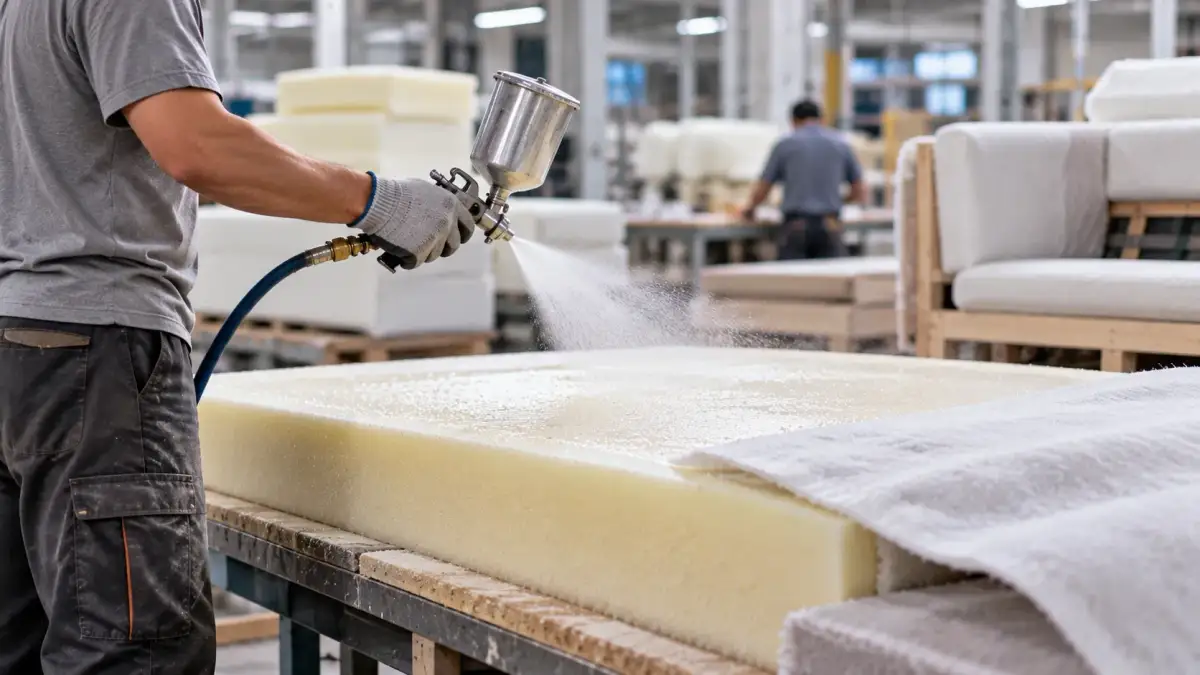
Spray Adhesive in Mattress and Sofa Manufacturing
Mattress and sofa manufacturing are among the largest volume applications for spray adhesive in the furniture and bedding industry. A typical spring mattress requires bonding 3-5 foam layers to each other and to the spring unit, plus attaching fabric quilting panels and border materials. A sofa may require dozens of separate adhesive bonds joining foam cushions to frames, fabric to foam, and structural components together.
The global mattress market produces over 500 million units annually, with manufacturing spread across virtually every country. Major production hubs include China, the United States, India, Turkey, and increasingly African countries like Kenya, Nigeria, and South Africa where domestic mattress production is growing rapidly to serve expanding urban populations. Sofa and upholstered furniture production follows a similar global distribution pattern.
Spray adhesive is the preferred bonding method in mattress and sofa production because of its speed — a spray gun can coat large foam surfaces in seconds, enabling production line speeds of 100-300 mattresses per shift. However, several adhesive-related challenges impact product quality and production costs:
- —Spray adhesive dissolving or damaging foam substrates (especially EPS and XPS)
- —Slow bond development reducing production line speed on high-volume orders
- —Uneven spray coverage causing bond gaps between foam layers
- —High adhesive consumption driving up per-unit material costs
- —VOC and odor concerns in finished mattresses affecting consumer acceptance
PACT manufactures spray adhesives specifically formulated for foam bonding applications. Our upholstery spray adhesive and foam spray adhesive are used by mattress and sofa factories across Africa, Southeast Asia, and the Middle East.
Bonding Operations in Mattress Production
Foam Layer Lamination
The primary adhesive operation in mattress production is bonding foam layers together and to the spring unit. PU foam sheets (comfort layer, support layer, edge support) are laminated in sequence using spray adhesive. The adhesive must bond foam-to-foam securely without dissolving the foam cell structure. Web spray application (intermittent lattice pattern) is the standard method, providing adequate bond strength with noticeably lower adhesive consumption than full-coverage spray.
Fabric and Quilting Panel Attachment
Mattress top and bottom quilting panels (fabric backed with thin foam) are bonded to the foam core using spray adhesive with full coverage application. This bond must hold through the quilting and tufting process and remain secure throughout the mattress service life. Higher tack adhesive formulations are used here compared to foam-to-foam bonding.
Sofa Cushion and Upholstery Assembly
Sofa production uses spray adhesive for bonding foam cushions to wooden or metal frames, wrapping fabric over foam padding, and attaching decorative elements. The adhesive must bond dissimilar materials (foam to wood, fabric to foam, fabric to metal) with consistent strength. Quick tack development is essential for production efficiency — operators need to handle bonded assemblies within seconds of joining.
Four Jobs, Four Different Requirements
"Foam bonding" covers jobs that fail in different ways. A grade that is right for laminating soft layers can bleed through a light cover fabric; one that holds fabric well can be wasteful on a large foam face. Match the job first, then the format.
| Job | What decides it | How it usually fails | Confirm before the trial |
|---|---|---|---|
| PU foam to cover fabric | Soft glue line, no show-through, fast enough tack to handle the piece | Adhesive strikes through light fabric, or the seat feels hard where it was sprayed | Fabric weight and colour, foam density, spray pattern and coat weight |
| Foam to foam, layer lamination | Cost per square metre and bond survival through compression cycles | Layers shear apart at the edges after repeated loading | Foam types in the stack — HR, memory, rebonded — and whether layers are rolled after joining |
| Foam to timber frame or board | Absorbency of the board side and the coat weight it needs | Glue line starved on the board side; foam lifts at corners | Board type and any lacquer or sealer, and whether staples also hold the part |
| EPS, XPS or other rigid foam inserts | Whether the solvent attacks the foam at all | The board surface softens, pits or shrinks after spraying | Exact board type and a patch test after the solvent has flashed off |
| PE or EPE foam parts | Low surface energy — many adhesives will not wet these at all | The bond peels cleanly off the PE surface with no adhesive left on it | Whether the part is genuinely PE or EPE; send a sample before we quote |
Bulk Gun, Water-Based or Aerosol
These are three different products, not one product in three containers. An aerosol carries propellant as well as adhesive, its spray pattern is fixed by the valve, and its cost per bonded square metre is normally several times that of a bulk system — which is why it belongs on repairs and short runs rather than on the line.
| Bulk drum and spray gun | Water-based, sprayed | Aerosol can | |
|---|---|---|---|
| Where it fits | Line production, large foam faces | Where VOC, odour or fire risk drives the change | Repairs, samples, low-volume workshops |
| Tack and drying | Fast tack; shortest wait before joining | Slower, and slower again in cold or humid air | Fast tack; limited control of coat weight |
| Equipment | Gun, hoses, pressure pot or pump; solvent cleaning | Equipment must suit a dispersion; water cleaning; must not freeze | None |
| Waste | Overspray is the main loss; web pattern reduces it | Overspray plus any adhesive lost to line stoppages | Propellant, unusable residue and part-used cans |
| Workplace and shipping | Flammable liquid; ventilation and dangerous-goods freight | Usually not a flammable liquid — check the grade SDS | Aerosols ship as dangerous goods whatever is inside |
| Cost basis | Price per kg × wet adhesive per m², plus overspray | Same, plus drying time on the line | Cost per can ÷ the area a can actually covers |
Compare candidates as cost per bonded square metre at the coat weight that passes your own peel and compression checks — not as price per kilogram, and not as the coverage printed on a can. Our water-based foam and upholstery page covers what we assess on request, and the selection guide lists what rules each option out.
What to send us for a foam trial
- —Foam types and densities in the stack, and the fabric or board on the other side
- —Spray equipment you run, or that you have none yet
- —Output per shift and how long a piece can wait before joining
- —Workshop temperature and humidity, and any ventilation limits
- —Odour or emission requirements your customer sets for the finished product
- —What is going wrong now, if you are replacing an adhesive: where it fails and how soon
Recommended Products for Mattress & Sofa Production
spray adhesive
Upholstery Spray Adhesive
Primary spray adhesive for mattress and sofa assembly. High-tack formula bonds foam-to-foam, foam-to-fabric, and foam-to-wood. Consistent spray pattern for uniform coverage.
View Product →spray adhesive
Foam Spray Adhesive
Foam-safe spray adhesive formulated with solvents that do not dissolve PU foam, EVA, or polystyrene. Essential for bonding sensitive foam types without structural damage.
View Product →Compare Other Technologies for This Application
Technical Considerations
Foam-Safe Solvent Selection
Standard spray adhesives may contain solvents (acetone, MEK, toluene) that dissolve or damage PU foam, XPS, and EPS substrates. Foam spray adhesive uses a carefully selected solvent blend that provides fast evaporation and strong tack without attacking the foam cell structure. PACT foam spray adhesive is formulated not to attack the common mattress and furniture foams — PU, HR (high resilience), memory foam, EVA and rebonded foam. Foam grades vary between suppliers, so run a test patch on a new foam before committing a production run.
Spray Equipment Optimization
Mattress and sofa production lines typically use pneumatic spray guns or automated spray systems with web spray nozzles. Web spray nozzles create a lattice pattern that provides intermittent adhesive coverage — sufficient for foam bonding while reducing adhesive consumption compared to full-coverage spray. We recommend a spray distance of 30-40 cm, air pressure of 3-4 bar, and web spray pattern for foam-to-foam bonding. Full spray coverage is used for foam-to-fabric and foam-to-wood bonding where stronger bonds are required.
Low Odor Requirements for Finished Products
Consumers are increasingly sensitive to chemical odors in mattresses and upholstered furniture. Adhesive residual odor contributes to the overall VOC profile of the finished product. Our low-odor spray adhesive formulations use fast-evaporating solvents that leave minimal residual odor after the recommended 24-hour off-gassing period. Mattress makers with low-emission targets increasingly look at water-based foam adhesives. These are sprayed from bulk systems rather than aerosol cans and need more drying time, so we assess them against your line and foam types rather than quoting one from stock.
Application Example
Mattress Factory in Kenya — Optimizing Spray Adhesive Consumption
A spring mattress manufacturer in Nairobi producing 200 mattresses per day was consuming 45 liters of spray adhesive daily using full-coverage spray application for foam layer bonding. After implementing PACT foam spray adhesive (SA-3300F) with web spray nozzles and optimized spray parameters, the factory reduced daily adhesive consumption to 28 liters — a 38% reduction — while maintaining equivalent bond quality. The adhesive cost saving of approximately $850 per month was achieved through better spray efficiency and optimized coverage rates, with no capital investment in new equipment.
Frequently Asked Questions
Will spray adhesive dissolve or damage foam?
What is the recommended application method for mattress assembly?
How much spray adhesive is needed per mattress?
Do you offer water-based spray adhesive for mattress production?
Can your spray adhesive be used in automated spray systems?
Related products and requirements
- Water-based foam and upholstery adhesives
Equipment, drying and glue-line feel when moving off solvent spray glue.
- Foam-safe spray adhesive for cushion assembly
Bonds PU foam without attacking the cell structure.
- Upholstery spray adhesive for fabric and covers
Adjustable tack for repositioning during pull-over.
- Application technique on open-cell foam
Coverage, spray pattern and the causes of delamination in service.
- Frame and panel bonding for the same factory
Contact adhesive for the carcass, spray for the soft parts.
- Contact adhesive for structural furniture joints
Where the bond has to carry shear rather than just hold fabric.
- Check the VOC limit for your destination market
Which instrument actually governs adhesives in the US, EU and China — and which ones are wrongly cited.
- Review our certifications and test reports
ISO 9001, ISO 14001, REACH statements and SGS reports, and what each one covers.
- Put your own brand on it — OEM and ODM
Custom labels, cartons and formulation adjustments from our existing lines.
- Send a specification and get a quote
Substrate, volume and destination market are enough for us to price it.
Need Spray Adhesive for Your Mattress or Sofa Factory?
Tell us your daily production volume and foam types. We will recommend the right spray adhesive and application method to optimize your bonding costs and quality.