
Industry Solutions
Adhesive Solutions for the Packaging Industry
Packaging adhesives by process — from corrugating and case sealing to box wrapping, labelling, PSA coating and protective foam inserts. Which chemistry each process needs, and which of them we supply, assess on request or do not carry.
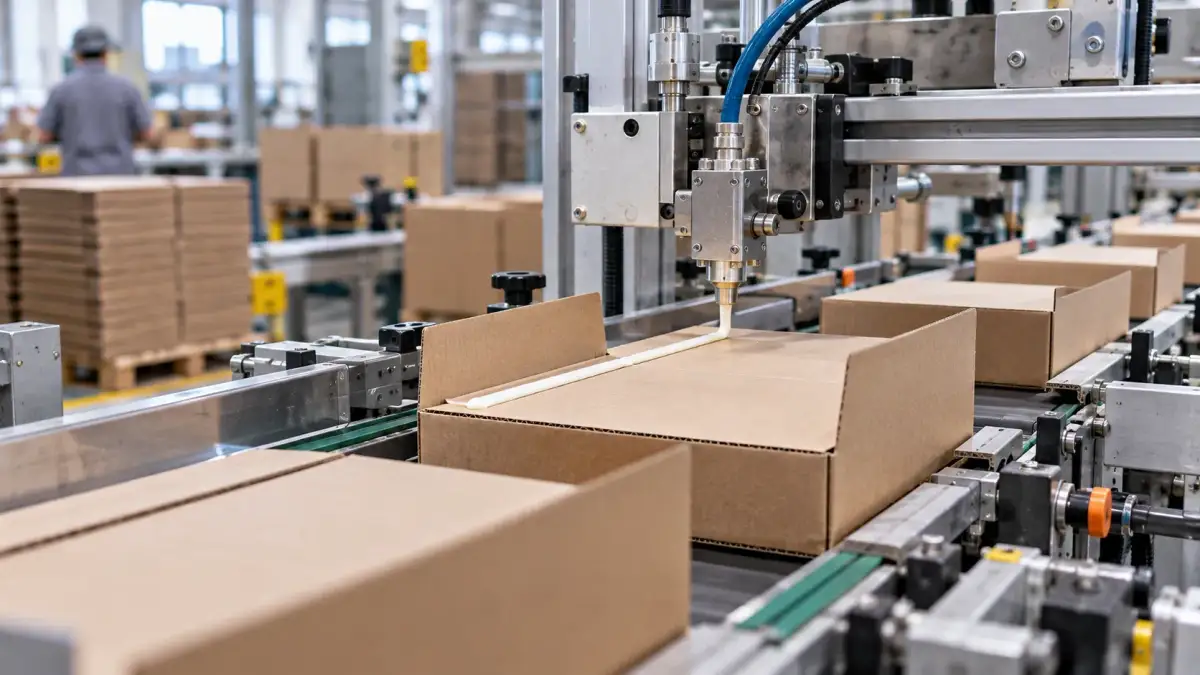
Adhesive Requirements in the Packaging Industry
The packaging industry is one of the largest consumers of adhesives globally, spanning applications from corrugated carton sealing and case closing to label application, flexible packaging lamination, and decorative box assembly. The adhesive must perform reliably at high production speeds, bond to a wide range of substrates including recycled materials, and maintain seal integrity through the supply chain from factory floor to end consumer.
Packaging production in emerging markets — Africa, Southeast Asia, the Middle East, and Latin America — faces additional challenges compared to developed markets. Higher ambient humidity, temperature fluctuations in warehouses without climate control, and increasing use of recycled fiber content in corrugated board all affect adhesive performance. Packaging adhesives must be formulated to handle these real-world conditions, not just laboratory ideal scenarios.
Common adhesive challenges in packaging operations include:
- —Carton sealing failure during transit causing product damage and customer complaints
- —Adhesive stringing and nozzle clogging on high-speed packaging lines
- —Inconsistent bond quality on recycled and coated corrugated board
- —Label peeling on curved surfaces and in cold storage environments
- —Increasing demand for food-safe and recyclable adhesive solutions
Start from the packaging job, not the product list. Carton sealing on automated lines normally runs on hot melt, and corrugating uses starch — neither is in our catalogue. For cartons, paper bags, tubes, box wrapping and wet-glue labels, our water-based paper and packaging page sets out what we assess on request. Our listed products fit narrower packaging jobs: foam spray adhesive for protective foam inserts, and neoprene contact adhesive for manual specialty work where fabric, leather or foam meets rigid board.
Coating label stock, tape or protective film is a different job from sealing cartons: it uses pressure-sensitive adhesives, most often water-based acrylics, specified by face stock, final surface and whether the label or film must come off cleanly.
Find Your Packaging Process
"Packaging adhesive" covers a dozen jobs that share little beyond the word. Corrugating, case sealing, box wrapping, labelling, coating and film lamination each use a different chemistry on different equipment, and an adhesive that suits one is usually wrong for the next. Find the process you run, then check what we can supply for it.
| Process | What the adhesive has to do | Usual chemistry | With us |
|---|---|---|---|
| Corrugating — fluting to liner | Set in seconds on a heated corrugator at web speed | Starch | Not in our catalogue |
| Case sealing and carton closing, automated | Instant set so flaps hold on the conveyor; no stringing at the nozzle | EVA hot melt | Not in our catalogue |
| Carton closing, manual or low speed | Longer open time, fibre tear on kraft and recycled board | Water-based PVAc or VAE | Assessed on request |
| Rigid box and gift box wrapping | Wet out printed paper without wrinkling, bleed-through or warping the board | Water-based paper and laminating adhesive | Assessed on request |
| Paper bags, tubes, cores, bookbinding | Machine stability and a bond that survives handling and humidity | VAE, PVAc, starch or dextrin | Assessed on request |
| Wet-glue labelling on bottles | Run on the labeller, hold on wet or chilled glass, wash off where returnable | Casein or synthetic wet-glue adhesive | Assessed on request |
| Coating label stock, tape or protective film | Tack, peel and shear held at a target coat weight and line speed | Water-based acrylic PSA | Assessed on request |
| Protective foam inserts and packaging fabrication | Bond foam pieces without attacking them; hold through transit | Solvent-borne spray adhesive | Listed product line |
| Presentation boxes with fabric, leather or foam | Bond on contact in manual, small-batch work | Neoprene contact adhesive | Listed product line |
| Flexible packaging lamination — film and foil | Bond strength and low migration after cure, on a laminator | Solventless or solvent-borne PU laminating adhesive | Not in our catalogue |
"Not in our catalogue" means the chemistry a job normally needs is one we do not supply — we list it so you can compare properly, not to imply we sell it. "Assessed on request" means we review your materials, equipment and documentation needs before quoting, because no stock grade is listed.
Corrugating and case sealing
These two consume the highest volume of adhesive in packaging, and both are equipment-led. Corrugating runs on starch mixed and applied at the machine; case sealing on an automated line runs on EVA hot melt applied from a heated tank through nozzles. Neither is a product we supply, and a solvent-borne contact adhesive is not a substitute for either. Where cartons are closed by hand or on a slow line, a water-based PVAc or VAE adhesive is the usual answer, and that we can assess — tell us the board, including recycled content, the line speed and how the carton is stacked afterwards.
Rigid boxes, gift boxes and paper converting
Premium boxes fail on appearance before they fail on strength: the wrap wrinkles, the printed paper shows adhesive through it, or the board warps as the water leaves. What decides it is the paper and board pair, the coat weight and how the box is pressed and dried, so send those with the enquiry. Water-based paper and laminating adhesives are the usual choice on a wrapping machine and are assessed on request; for small-batch manual work where fabric, leather or foam meets rigid board, neoprene contact adhesive is a listed line.
Labelling: wet-glue and pressure-sensitive are different products
A wet-glue label is applied from a glue pot on the labeller, and the adhesive has to run on that machine, grip a wet or chilled bottle and — for returnable glass — wash off in caustic. A pressure-sensitive label arrives already coated on its face stock and liner; the adhesive decision was made by whoever coated it. If you are applying labels, tell us which of the two you run. If you are coating the label stock, that is the next section.
Coating label stock, tape and protective film
Pressure-sensitive coating is a converting process, not a packaging one: a water-based acrylic is metered onto face stock or film at a target dry coat weight, dried and wound. It is specified by face stock, the final surface, whether the label or film must come away cleanly, and the coater and oven you run. Our water-based acrylic page sets out the test methods and what to state when you enquire.
Protective foam inserts
Foam inserts for cases and cartons are bonded with spray adhesive, and the constraint is foam compatibility rather than strength: many solvents attack polystyrene, and PE or EPE foams have a low-energy surface that most adhesives will not wet. Our foam spray adhesive is formulated for PU, EVA and polystyrene boards — patch-test your own board first, and send a sample if the insert is PE or EPE.
Flexible packaging lamination
Laminating film to film or film to foil uses solventless or solvent-borne PU laminating adhesives on a laminator, with migration and cure requirements that food packs are assessed against as a finished structure. We do not supply these, and say so rather than offering a substitute: an adhesive from another process will not meet the bond or migration requirements of a laminate.
Recommended Products for Packaging
spray adhesive
Foam Spray Adhesive
For protective foam insert fabrication — bonding PU, EVA or polystyrene foam pieces into packaging inserts. PE and EPE foams need a surface check first. Not a carton sealing adhesive.
View Product →contact adhesive
Neoprene Contact Adhesive
For small-batch, manual specialty work such as bonding fabric, leather or foam to rigid presentation boxes. Not a carton sealing or labelling adhesive.
View Product →Compare Other Technologies for This Application
Technical Considerations
Adhesive Selection for Different Packaging Substrates
Packaging materials range from virgin kraft paper to recycled corrugated board, coated carton board, plastic films, and composite materials. Each substrate has different surface energy and porosity characteristics that affect adhesive performance. Recycled corrugated board with high recycled fiber content has lower surface energy and more surface contamination than virgin materials, requiring adhesives with stronger wetting properties. Coated and laminated boards may need corona treatment or primer application for reliable bonding.
Production Line Speed Considerations
Packaging lines are equipment-led, and the adhesive has to fit the machine rather than the other way round. Open time, set speed and viscosity stability decide whether cartons hold on the conveyor or flaps spring open, and whether nozzles string or clog. That is why the line matters more than the product name in an enquiry: tell us the equipment, the speed, the board or substrate and the ambient conditions, and we will say which process we can supply for and which needs the chemistry that machine was built around — hot melt for high-speed case sealing, starch for corrugating.
Environmental and Food Safety Compliance
Adhesives in food and pharmaceutical packaging are assessed as part of the finished pack — for example under FDA 21 CFR 175.105 in the US, or EU Regulation 1935/2004 with migration testing — so suitability depends on the pack structure, contents and conditions rather than on the adhesive type. Even for non-food packaging, there is increasing demand for low-VOC, recyclable-compatible adhesives that do not interfere with paper recycling processes. We provide compliance documentation and formulation data for food-contact and recyclability assessments.
Application Example
Illustrative scenario — protective foam inserts for an exporter
This is an example of how a packaging enquiry is handled, not a customer record. A fabricator making foam inserts for export cases asks for a spray adhesive. The first questions are which foams the insert uses, because a solvent that suits PU and EVA can attack polystyrene and will not wet PE or EPE at all; then whether the inserts are sprayed by gun or aerosol and at what output; then what the cases see in transit, since a bond that holds in an air-conditioned workshop can creep in a hot container. From there we send the candidate grade with its TDS and SDS, the coat weight and open time to work to, and ask for a patch test on the actual foam before a production trial. Where the insert turns out to be PE or EPE, we say so and ask for a sample rather than quote a grade that will not hold.
Frequently Asked Questions
What adhesive is recommended for corrugated carton sealing?
Can your adhesives be used in food packaging applications?
How do you ensure consistent adhesive performance on recycled board?
What packaging formats do you offer for packaging industry adhesives?
Related products and requirements
- Water-based adhesives for cartons, bags, tubes and labels
Coated board, wet-glue labelling, cold seal and food contact.
- Acrylic adhesives for label stock, tapes and protective film
Specifying face stock, final surface, removability and coating conditions.
- Foam fabrication for protective packaging
Bonding EPE, EVA and PU inserts without distorting them.
- SBS contact adhesive for board and carton work
The economical choice where heat resistance is not the constraint.
- Getting consistent bonds at line speed
Coat weight, open time and the timing errors that cause most failures.
- Panel and board bonding
Adjacent processes running the same chemistries.
- Check the VOC limit for your destination market
Which instrument actually governs adhesives in the US, EU and China — and which ones are wrongly cited.
- Review our certifications and test reports
ISO 9001, ISO 14001, REACH statements and SGS reports, and what each one covers.
- Put your own brand on it — OEM and ODM
Custom labels, cartons and formulation adjustments from our existing lines.
- Send a specification and get a quote
Substrate, volume and destination market are enough for us to price it.
Need Adhesive Solutions for Your Packaging Operation?
Tell us about your packaging substrates, line speeds, and application requirements. We will recommend adhesive products optimized for your production environment.