
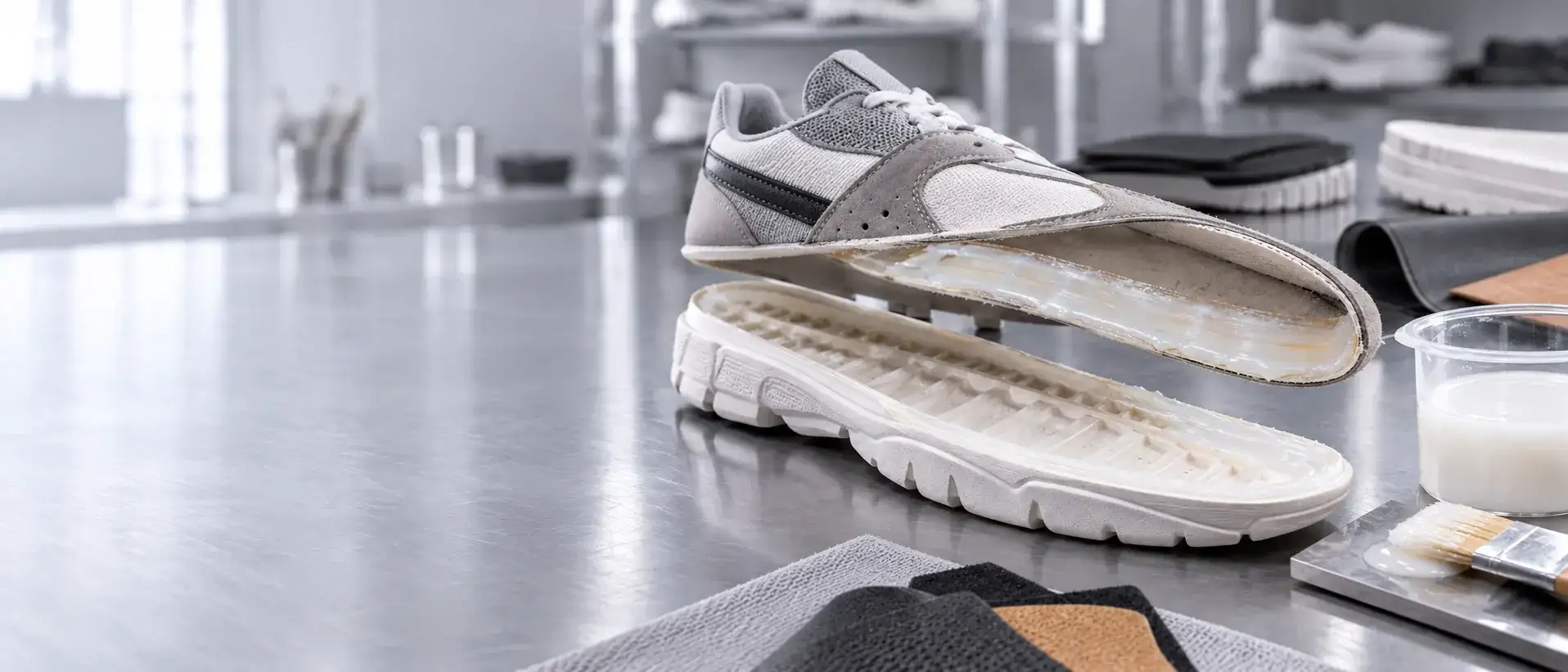
Water-Based PU Shoe Adhesives
Water-based polyurethane dispersions are used for sole attaching and other footwear bonding steps where brands or factories want less solvent at the adhesive station. They work as part of a system — cleaning, primer or halogenation, hardener, drying and heat activation — so a switch is judged on the whole process, not the adhesive alone.
An application we assess on request. Share your substrates, process and target requirements and we will confirm suitability, available documentation and sourcing feasibility — no stock grade is listed yet.
Discuss Your Application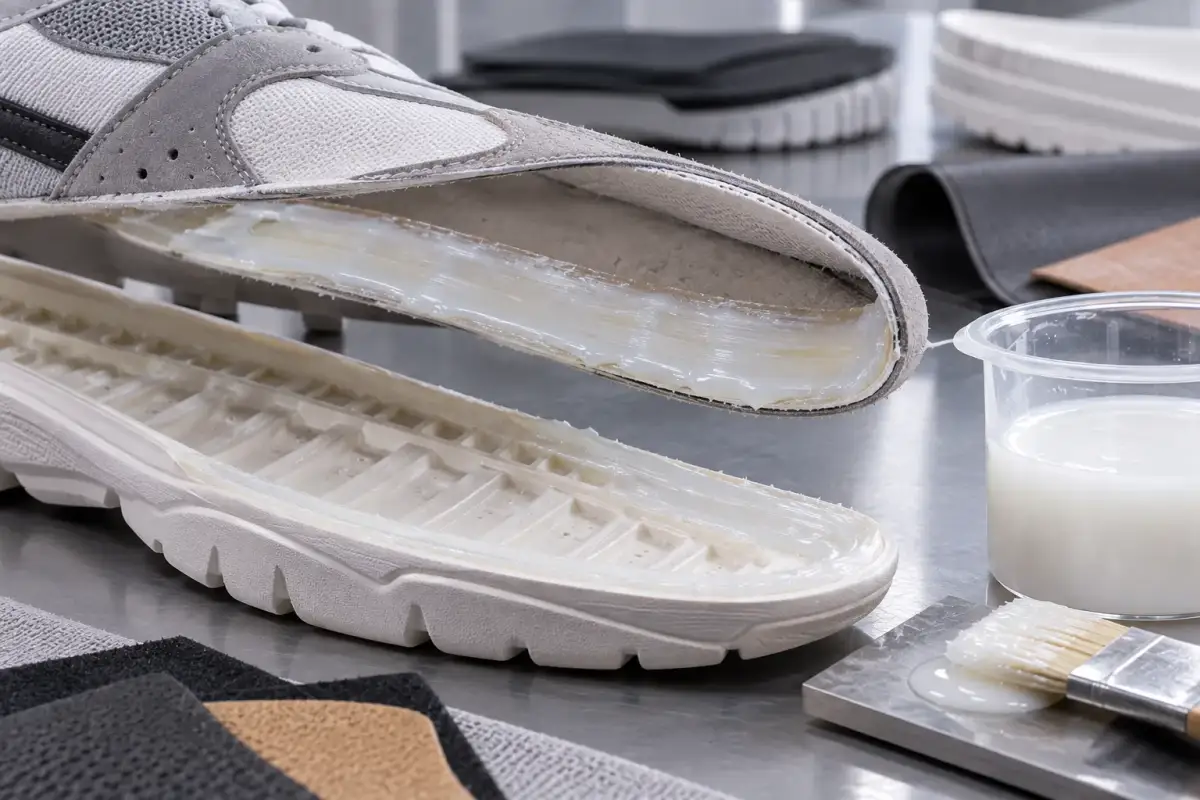
Sole Materials and Their Preparation
A water-based adhesive does not change what each sole material needs before bonding. Uppers matter too: leather is roughed, coated synthetics may need a primer on the upper side, and textiles can let adhesive strike through.
| Sole | Usual preparation | Watch for |
|---|---|---|
| Vulcanised rubber | Buffing, then halogenation or a rubber primer | Treated soles have a working window before they must be bonded |
| TR / TPR | Halogenation or a primer matched to the compound | Compounds vary between sole suppliers; re-test when the supplier changes |
| EVA / Phylon | A primer matched to EVA | A rubber primer on EVA is a common cause of separation |
| PU | Cleaning to remove mould release, sometimes a primer | Release agent left on the sole is the usual failure |
| PVC | A primer suited to plasticised PVC | Plasticiser migrating from the sole can soften the bond over time |
One or Two Components
Sole bonds usually need a crosslinker (hardener) mixed into the dispersion to reach the heat and hydrolysis resistance brands test for. That brings a mixing ratio to control and a pot life: mixed adhesive left at the end of the shift is discarded as its SDS directs, not thinned and reused. Lighter-duty steps may run without hardener. Our shoe adhesive guide explains how cleaners, primers, halogenation agents and hardeners differ.
Drying, Heat Activation and Pressing
- Dry completely. Water left in the film when it is activated weakens the bond. Drying tunnels sized for solvent adhesive are often too short.
- Activate to a film temperature. The adhesive film must reach the activation temperature on its TDS; the unit's setpoint is not the same thing. Check with a surface thermometer or indicator.
- Press within the window. An activated film stays bondable only briefly. Record how long pairs wait between activation and the press.
- Press evenly. Pressure and time come from the sole press and the sole shape; uneven pressure shows up as edge separation.
Heat, Hydrolysis and Flex Requirements
Brands specify bond strength before and after ageing — heat, humidity, sometimes flexing. Standards such as EN 1392 (bond strength of footwear adhesives) and ISO 17708 (upper-sole adhesion on the whole shoe) describe how to test; the pass mark comes from the brand. Tell us the method and the values you have to meet, and test aged pairs, not only fresh ones: hydrolysis is where an under-crosslinked bond fails after shipping.
Restricted Substances and Brand Requirements
Water-based does not mean compliant. Brand restricted substance lists and the ZDHC MRSL apply to each chemical product on the line — adhesive, hardener, primer and cleaner — and documentation has to name those products. Ask for declarations per product rather than a general statement about the adhesive type.
What to Tell Us
| Parameter | Why it matters | What to tell us |
|---|---|---|
| Bonding step | Sole attaching, lasting and insole lamination need different adhesives. | The step, not just "shoe glue" |
| Sole material and compound | Decides the preparation and the primer. | Material and supplier compound name if known |
| Upper material | Leather, coated synthetics and textiles wet and absorb differently. | Material and finish |
| Current preparation | A water-based adhesive is judged with the primer or halogenation it will run with. | Cleaner, primer and halogenation products now used |
| Drying and activation equipment | Water must dry fully before activation; tunnel length and activation units set what is achievable. | Dryer type and length, activation unit |
| Brand test and limit | Brands name the method and set the pass mark, before and after ageing. | Method, required values, ageing conditions |
| Current adhesive and any problem | Gives a baseline to compare against. | Product name, TDS, failure description |
For the solvent-borne grades we list, see PU shoe adhesive and neoprene shoe adhesive; for diagnosing a separated pair, see reading a sole failure.
Frequently Asked Questions
Does a water-based PU shoe adhesive need a hardener?
Do I have to change my production line?
Are the primers still solvent-based?
Does water-based adhesive automatically meet brand chemical requirements?
Can one adhesive system bond both EVA and rubber soles?
How should we trial a switch from solvent-based adhesive?
Sources
- Covestro, New adhesive solutions for automotive and footwear industries
- Covestro, Wet bonding with water-based PU and polychloroprene
- ZDHC, Manufacturing Restricted Substances List (MRSL)
These references describe the technology in general. Performance figures from other manufacturers apply to their products, not to PACT grades, and a citation does not imply endorsement. Content reviewed September 14, 2026.
Related guidance for footwear bonding
- Choosing shoe adhesive by bonding step
Primers, hardeners and how to read a separated sole.
- The solvent-borne PU shoe adhesive we list
Sole bonding grade — ask for the bond-strength report on your own materials.
- The footwear bonding process step by step
From roughing to cold setting.
- What footwear factories specify
Materials, climates and brand testing.
- All water-based adhesive options
Chemistries compared by application.
- Check the VOC limit for your destination market
Which instrument actually governs adhesives in the US, EU and China — and which ones are wrongly cited.
- Review our certifications and test reports
ISO 9001, ISO 14001, REACH statements and SGS reports, and what each one covers.
- Send a specification and get a quote
Substrate, volume and destination market are enough for us to price it.
Share Your Materials and Process
Share the materials you need to bond or coat, your application process and any target specification. We will review the request and confirm sourcing feasibility, available documentation and next steps.