
Technical reference
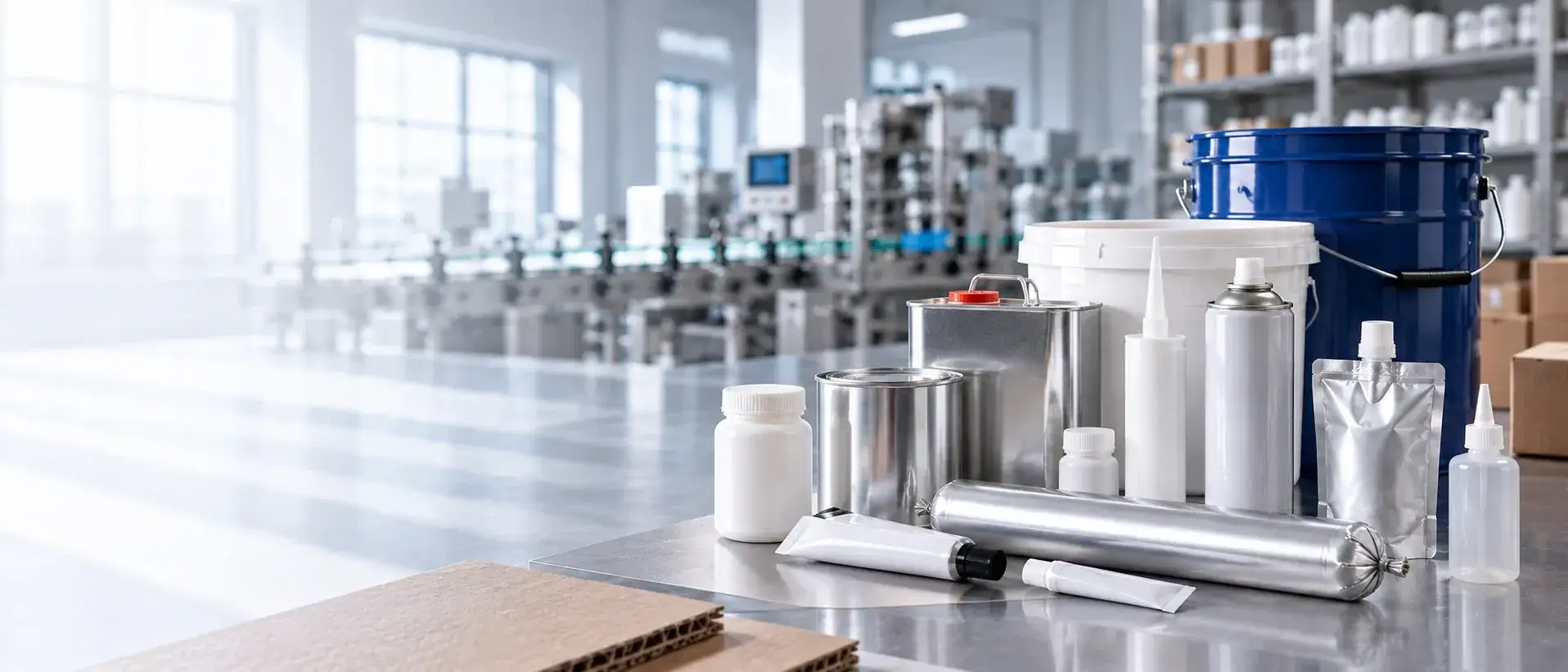
Adhesive Packaging Formats
Tins, drums, pails, aerosols, cartridges and sausages — what each suits, what it costs you, and why the format your market expects may not be the one a supplier quotes.
Last updated: 2026-09-07
Format is a cost decision, not a detail
Packaging is a substantial share of what a filled adhesive costs, and the format decides whether the product runs on your customers' equipment at all. It is usually the last thing discussed in an enquiry and one of the first things that goes wrong.
Two questions settle most of it: what equipment does the end user already own, and how much do they get through in a month.
The formats
Tin can
0.5L · 1L · 3L · 15LFor: Brush and roller application, small workshops, retail and trade counter sale
Every opening loses solvent. On a busy line, decant into a smaller vessel rather than working from an open 15L.
Drum
200LFor: Production lines with a pump or gun feed
The most economical format per kilogram, and the one most exposed to solvent loss and contamination if left open.
Pail
1L · 5L · 20LFor: Water-based grades and trowel-applied products
Water-based product in a pail must not freeze — a frozen dispersion is finished and looks normal once thawed.
Aerosol can
450ml · 550ml · 650mlFor: Spray application without a gun or compressor — upholstery, foam, site work
Ships as UN 1950 regardless of contents, stores upright, and must stay below 50°C. The propellant is part of what you pay for, so compare coverage per can rather than volume.
Cartridge
280ml · 300mlFor: Sealant and construction adhesive from a standard caulking gun
Regional standards differ. Confirm the cartridge fits the guns your market already owns before ordering a container of them.
Sausage / foil pack
590mlFor: High-volume sealant application from a sausage gun
Less packaging waste and better shipping density than cartridges, but needs the right gun — which your customers may not have.
What each product is available in
| Product | Available formats |
|---|---|
| Neoprene Contact Adhesive | 0.5L, 1L, 3L, 15L tin cans; 200L drums |
| SBS Contact Adhesive | 0.5L, 1L, 3L, 15L tin cans; 200L drums |
| Water-Based Contact Adhesive | 1L, 5L, 20L pails; 200L drums |
| PU Shoe Adhesive | 1L, 3L, 15L tin cans; 200L drums |
| Neoprene Shoe Adhesive | 0.5L, 1L, 3L, 15L tin cans; 200L drums |
| Upholstery Spray Adhesive | 450ml, 550ml, 650ml aerosol; 20L drum for spray gun application |
| Foam Spray Adhesive | 450ml, 550ml, 650ml aerosol; 20L drum for spray gun application |
| Neutral Silicone Sealant | 280ml, 300ml cartridge; 590ml sausage; 20L pail |
| Acetoxy Silicone Sealant | 280ml, 300ml cartridge; 590ml sausage; 20L pail |
Your market's formats are not ours
Pack sizes are regional conventions, and a supplier quoting their standard format is quoting you a repackaging problem. The conversions are arithmetic; the tooling is not.
| Our format | US equivalent | Note |
|---|---|---|
| 280 ml cartridge | ≈ 9.5 fl oz | US trade standard is 10 oz — close but not identical |
| 300 ml cartridge | ≈ 10.1 fl oz | The nearest match to a US 10 oz cartridge |
| 590 ml sausage | ≈ 20 fl oz | US sausage packs are commonly 20 or 29 oz |
| 550 ml aerosol | ≈ 18.6 fl oz | Aerosol fill weight matters more than volume — ask for both |
| 20L pail | ≈ 5.3 US gal | Close to a US 5-gallon pail but not interchangeable on a filling line |
| 200L drum | ≈ 53 US gal | The 55-gallon US drum is a different container |
"Close enough" is not close enough on a retail shelf. A 280ml cartridge sold against a 10 oz competitor looks like short measure whether or not it is. Tell us the format your market expects at the enquiry stage — it is anOEM setup question, not an afterthought.
Frequently asked questions
Can you supply adhesive in US gallon pails and ounce cartridges?
Which packaging format is cheapest?
Does the packaging format change the dangerous goods classification?
How many units fit in a container?
Can we have our own brand printed on the packaging?
What packaging do you recommend for a first trial order?
Format, cost and shipping
- What happens between order and container
Eight stages with real durations, and the three places programmes actually stall.
- Printed labels and printed cans
Where a format decision becomes a tooling decision, and what each costs to start.
- Modelling landed cost rather than ex-works
Format decides container fit, which decides freight per unit.
- Storage, shelf life and what heat does to it
Why a container crossing the tropics at 60-70°C is the hardest storage condition your adhesive will see.
- How to read the numbers on a datasheet
What each figure predicts, what it does not, and why one without its test method is not comparable.
- Look up a term and its other names
Non-acid silicone is neutral cure; liquid nails is grab adhesive. Fifty terms with their synonyms.
- Eight checks before you pick a supplier
Manufacturer or trader, grade-level test data, VOC position and dangerous-goods handling — apply them to us too.
- Put your own brand on it — OEM and ODM
Custom labels, cartons and formulation adjustments from our existing lines.
- Browse the full technical library
Every reference page and guide, grouped by the question it answers rather than by date.
- Send a specification and get a quote
Substrate, volume and destination market are enough for us to price it.

Tell us the format your market expects
Cartridge size, can volume, pail or drum — and what equipment your customers already own. We will tell you what runs from stock and what needs an OEM setup, with the cost of each.