
Industry Solutions
Adhesive Solutions for Automotive Interior Manufacturing
High-performance spray and contact adhesives for headliner bonding, carpet lamination, door trim assembly, and seat cushion fabrication. Heat resistant formulations engineered for vehicle interior temperatures.
·OEM-qualified formulations · SGS-tested VOC data · DIN 75201 / VDA 277-278 compliant
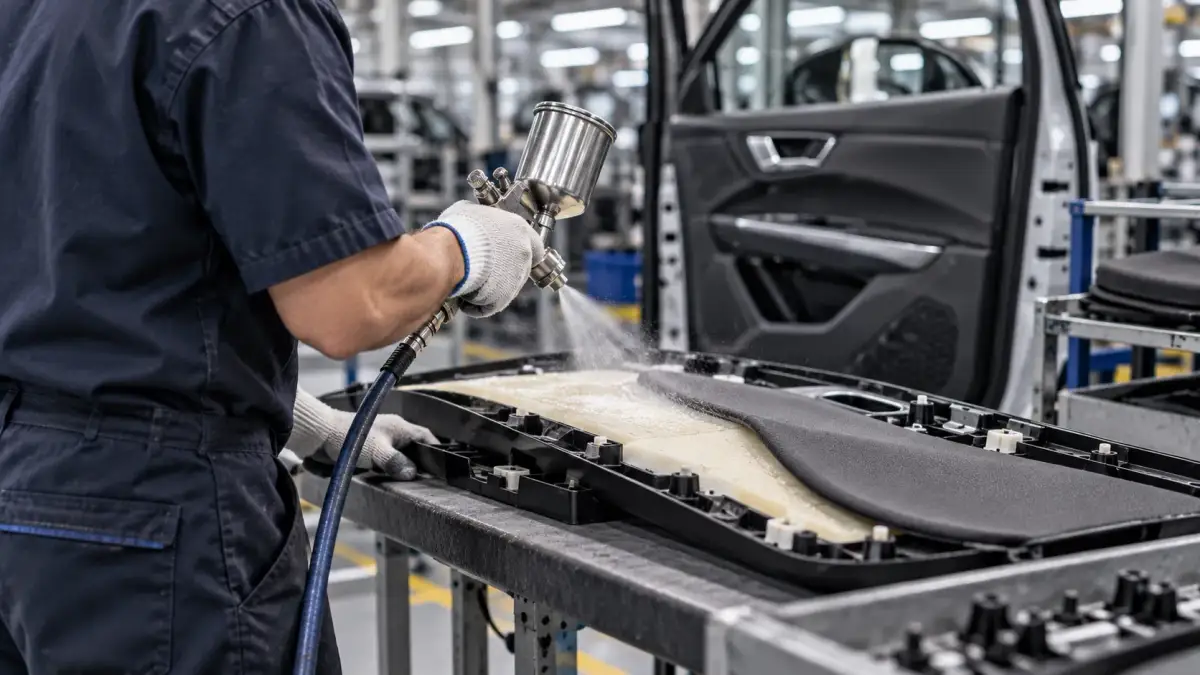
Adhesive Requirements for Automotive Interiors
Automotive interior assembly represents one of the most technically demanding adhesive applications in manufacturing. Every vehicle interior contains dozens of bonded joints — headliner fabric to roof panel, carpet to floor pan, door trim panels to door frames, seat fabric to foam cushions, and acoustic insulation to body panels. These bonds must withstand extreme temperature cycling, UV exposure through windshields, vibration, and a service life exceeding 10-15 years.
The automotive adhesive market is driven by two major trends: the shift from mechanical fasteners to adhesive bonding for weight reduction and NVH (noise, vibration, harshness) improvement, and increasingly stringent VOC emission standards for vehicle cabin air quality. Component suppliers serving OEMs (original equipment manufacturers) must qualify their adhesives through rigorous testing protocols that evaluate bond strength, aging resistance, thermal cycling, and chemical emissions.
Common adhesive challenges in automotive interior manufacturing include:
- —Headliner sagging caused by adhesive failure at elevated interior temperatures (80°C+)
- —Delamination of door trim panels and carpet during thermal cycling
- —VOC off-gassing from adhesives affecting vehicle interior air quality standards
- —Inconsistent spray adhesive coverage leading to bond gaps and visual defects
- —Difficulty bonding dissimilar materials (fabric to foam, foam to metal, plastic to fabric)
PACT supplies spray adhesives and contact adhesives formulated for automotive interior applications. Our products are used by Tier 1 and Tier 2 automotive component suppliers producing headliners, door panels, seats, and trim components for both passenger vehicles and commercial vehicles.
Key Automotive Interior Bonding Applications
Headliner Bonding
The headliner is the fabric-covered panel lining the vehicle roof interior. It consists of a polyester or non-woven fabric laminated to a PU foam backing, bonded to a semi-rigid substrate (fiberglass, cardboard, or plastic). Spray adhesive is applied to both surfaces, and the assembly is pressed in a heated mold. The critical requirement is sustained heat resistance above 100°C — vehicle roof surfaces in tropical and desert markets regularly exceed 80°C under direct sunlight, and adhesive failure at these temperatures causes the headliner to sag away from the roof panel.
Why headliner adhesive is not ordinary foam spray glue
- —Sustained heat under the roof. A headliner hangs from the adhesive at cabin temperatures that general foam glue is not built for, so the failure is slow sagging (creep), not a sudden peel.
- —Emissions. Fogging and VOC tests such as DIN 75201 and VDA 278 apply to the finished part, which a workshop foam glue has never been checked against.
- —Original assembly or repair. Factory headliners are usually bonded in forming with heat-activated, water-based or hot-melt systems; aerosol high-temperature grades are mostly for repair and aftermarket work. The qualification route is different for each.
Our listed upholstery and foam spray grades are specified to +70°C and +80°C and are not headliner grades. Headliner work needs a high-temperature grade qualified on your parts at your worst-case temperature.
Carpet and Floor Covering
Automotive carpet is bonded to molded sound-deadening pads and floor panels using spray adhesive. The adhesive must withstand foot traffic, moisture from shoes and cleaning, and temperature variations between the heated cabin and cold floor pan. Coverage uniformity is critical — missed areas create loose carpet that shifts underfoot and generates noise.
Door Trim and Dashboard Assembly
Door trim panels, dashboard covers, and center console surfaces are typically fabric or vinyl wrapped over rigid plastic substrates. Neoprene contact adhesive is used for manual wrap operations where operators apply adhesive to both surfaces, position the covering material, and press by hand or with tooling. The adhesive's heat resistance to 120°C prevents trim delamination in parked vehicles.
Seat Assembly and Acoustic Insulation
Seat foam cushions are bonded to wire frames and trim covers using foam-safe spray adhesive. The adhesive must not dissolve PU foam, must keep its bond through the OEM's own seat durability test, and must remain non-staining on visible upholstery. Acoustic insulation — dash panel mats, wheel-arch liners, and trunk liners — is bonded to sheet metal using high-temperature spray adhesive rated for sustained 90°C exposure from engine-bay proximity.
Adhesive Specifications by Interior Application
Each interior application has distinct thermal, mechanical, and emission requirements. Matching the adhesive chemistry to the specific OEM specification is the first step in passing Tier 1 qualification.
| Application | Recommended Chemistry | Heat Resistance | Peel Strength Target | Key Standard |
|---|---|---|---|---|
| Headliner (fabric-to-foam-to-substrate) | High-temp solvent spray / web-spray water-based | 100-105°C sustained | ≥ 2.5 N/25mm (ISO 11339) | SAE J1756 fogging |
| Carpet / sound-deadening pad to floor pan | High-tack solvent spray | 80°C sustained | ≥ 3.0 N/25mm | FMVSS 302 flammability |
| Door trim / dashboard wrap | Neoprene contact adhesive, brush/roller | 120°C peak | ≥ 4.0 N/25mm | ASTM D1876 T-peel |
| Seat foam to frame / cushion lamination | Foam-safe spray (no MEK/toluene) | 70°C sustained | ≥ 1.5 N/25mm + OEM flex durability | OEM seat durability test |
| Acoustic insulation / wheel-arch liner | High-temperature solvent spray | 90°C sustained | ≥ 2.0 N/25mm | ISO 3795 / FMVSS 302 |
| Weatherstrip and seal bonding | Neoprene contact or PU reactive | 100°C sustained, -40°C flex | ≥ 5.0 N/25mm | OEM-specific |
Automotive Adhesive Test Standards Reference
OEM qualification packages typically require test data against the following standards. Understanding what each test measures lets you build a qualification file that passes the first review cycle rather than being returned for additional data.
Mechanical
ISO 11339 / ASTM D1876 (T-peel)
180-degree peel strength measurement on flexible-to-flexible bonds. Reference for headliner fabric-to-foam and seat trim covers. Typical target ≥ 2.5 N/25mm.
Mechanical
SAE J1756 (Thermal Aging)
168-hour accelerated aging at 90°C with subsequent peel testing. The standard qualification gate for any adhesive bonded to the vehicle roof or upper dash assembly.
Emissions
VDA 277 (Total Organic Carbon)
FID measurement of total carbon emissions in mg/g. German OEM reference for interior component VOC screening. Typical spec: less than 100 mg C per kg sample.
Emissions
VDA 278 (VOC + FOG thermal desorption)
Separates volatile (VOC, C6-C16) and semi-volatile (FOG, C14-C32) emissions by GC-MS. Core requirement in BMW, Mercedes, VW, Volvo interior specs.
Emissions
DIN 75201 (Windshield Fogging)
Gravimetric (Method A) or reflectometric (Method B) measurement of windshield fogging potential. Method A target typically less than 2 mg condensate; Method B target ≥ 90% gloss retention.
Emissions
VDA 270 (Odor)
Trained-panel sensory evaluation at 23°C, 40°C, and 80°C storage. 6-point scale (1 = not perceptible, 6 = very strong). Interior components typically must score ≤ 3.0.
Safety
FMVSS 302 / ISO 3795 (Flammability)
Horizontal burn test. US and international regulation for interior materials — burn rate must not exceed 102 mm/minute. Mandatory for all US-market vehicles.
Cabin Air
GB/T 27630 / ISO 12219-1
Chamber testing of the complete assembled vehicle cabin. China's GB/T 27630 limits formaldehyde, benzene, toluene, xylene, and styrene. Adhesive contribution is measured at the component level upstream.
How Adhesive OEM Qualification Actually Works
Component suppliers sourcing new adhesives face a structured qualification process that typically runs 8-14 weeks from initial sample request to production release. Understanding the sequence helps you plan timing for program launches and change-management reviews.
Week 1-2
Supplier Technical Package
TDS, SDS, VOC/emissions data (VDA 277/278, DIN 75201), REACH SVHC declaration, and initial peel/heat-aging reports. At PACT, we typically ship this package within 48 hours of request for all standard products.
Week 2-5
Tier 1 Internal Screening
Adhesive is tested on the actual program substrates (specific fabric lot, specific foam, specific substrate). Screening covers wet-out, open time, peel strength, heat-aging per SAE J1756, and cohesive-vs-adhesive failure mode. About 40% of candidates are eliminated here.
Week 5-9
Component-Level Build and OEM Submission
Full components (complete headliners, complete door trims) are built using the candidate adhesive and submitted to the OEM for cabin-air chamber testing (GB/T 27630 China, ISO 12219 international, or OEM-specific internal standard).
Week 9-12
Accelerated Aging on Complete Assembly
Thermal cycling (-30°C to 90°C), humidity exposure (85°C/85% RH for 168-500 hours), and UV aging (SAE J2527 xenon-arc). Post-aging peel testing confirms bond durability through the vehicle service life.
Week 12-14
PPAP and Production Release
Production Part Approval Process documentation is submitted: control plan, PFMEA, capability studies (Cpk targets typically ≥ 1.33 on peel strength and VOC content), and ongoing batch-testing protocol. Once approved, the adhesive is released for serial production with batch traceability.
Related Technical Guides
Automotive interior buyers typically also evaluate regulatory compliance across multiple markets. These two guides cover the adjacent topics most relevant to OEM adhesive sourcing:
- Low VOC Contact Adhesive: A Buyer's Guide to Compliance → — VOC content vs emissions, test methods, and sourcing from compliant manufacturers.
- REACH Compliant Adhesive: What Importers Need to Know → — SVHC substances, required documentation, and supplier verification for EU import.
- Certifications & Test Reports → — SGS, Intertek, and accredited-lab test reports available with every PACT shipment.
Two checks specific to automotive interior suppliers
Most buyers arriving at this page are not yet comparing adhesive grades — they are comparing suppliers, and trying to work out which manufacturers can actually hold an interior specification in production rather than in a sample tin. The two checks below are the ones specific to automotive interior work. The general ones — manufacturer or trading company, formulation control, documentation, dangerous goods — apply to any adhesive purchase and are set out in how to choose an adhesive manufacturer.
1. Ask for fogging and emissions data before anything else
Interior adhesives live or die on DIN 75201 fogging, VDA 277 total carbon emission and VDA 278 VOC/FOG thermal desorption. A supplier who can send a current accredited-lab report for the exact grade you are quoting has done the work; one who offers a generic company-level certificate has not. Ask which laboratory issued it and on what date — reports older than about two years are routinely rejected during OEM re-qualification.
2. Confirm heat-ageing performance at your worst case, not the datasheet case
A parked car's roof cavity reaches 90-105°C in summer sun. A bond quoted as heat resistant to 100°C on a datasheet may have been tested for one hour, not the 500-hour heat-ageing cycle interior programmes require. Specify the dwell time and temperature you actually need and require peel strength retention after ageing, not just initial peel.
PACT manufactures its own automotive interior adhesive range in Nansha, Guangzhou, and supplies OEM and ODM programmes with per-batch documentation. Request current DIN 75201 and VDA 278 reports through our technical enquiry form.
Common Interior Bond Failures and Their Causes
Nearly every interior adhesive complaint we investigate resolves to one of five causes, and only one of them is the adhesive itself. Working through these in order usually identifies the problem faster than reformulating.
| Symptom | Most Likely Cause | First Check |
|---|---|---|
| Headliner sags after summer parking | Heat-ageing limit exceeded at 90-105°C roof cavity temperature | Peel strength retention after 500h at 100°C, not initial peel |
| Bond fails at the foam, not the glue line | Foam tear — adhesive is stronger than the substrate | Foam tensile rating; this is a substrate spec issue, not adhesive |
| Edges lift on door trim within days | Insufficient open time before mating, or contaminated substrate | Flash-off time against line speed; mould release residue on the trim |
| Windscreen haze after assembly | Fogging — plasticiser or tackifier volatiles condensing on glass | DIN 75201 Method B reflectometric value for the exact grade |
| Persistent cabin odour on new units | Residual solvent retained in a closed laminate structure | VDA 277 total carbon; consider a water-based system qualified on your parts (trim laminate tests) |
Odour and fogging complaints usually point toward low-VOC adhesive selection; heat failures point toward heat-resistant chemistry.
Recommended Products for Automotive Interior
spray adhesive
Upholstery Spray Adhesive
High-tack spray adhesive for carpet, door trim and fabric bonding, specified to +70°C. Headliners need a high-temperature grade qualified on your parts.
View Product →spray adhesive
Foam Spray Adhesive
Spray adhesive formulated for bonding PU foam to substrates without dissolving the foam structure. Used in seat cushion assembly and acoustic panel installation.
View Product →contact adhesive
Neoprene Contact Adhesive
Brush-grade contact adhesive for manual assembly operations — trim attachment, weatherstrip bonding, and small part assembly. Heat resistance to 120°C.
View Product →Compare Other Technologies for This Application
Technical Considerations
Temperature Requirements for Automotive Interior Adhesives
Vehicle interiors experience extreme temperature cycling. In tropical and desert markets, dashboard and headliner surface temperatures regularly exceed 80°C under direct sunlight. Even in temperate climates, parked vehicles reach 60-70°C interior temperatures in summer. All adhesives used in automotive interior bonding must maintain their bond strength across this temperature range. PACT spray adhesives for automotive applications are formulated with heat-resistant polymer blends and tested at sustained 100°C exposure for headliner bonding and 80°C for general trim applications.
VOC and Fogging Compliance
Automotive OEMs impose strict limits on VOC emissions and fogging from interior components. Adhesives contribute to the total VOC load measured inside the vehicle cabin. Our automotive-grade adhesives are tested for VOC content, fogging value (DIN 75201), and odor emission to help component suppliers meet OEM specifications. Low-VOC and water-based alternatives are available where the performance requirements permit.
Spray Equipment and Application Parameters
Automotive interior adhesive application typically uses pneumatic spray guns with specific nozzle sizes and spray pressures to achieve consistent coverage. For headliner bonding, a wet film thickness of 40-60 microns is targeted. Under-application causes bond gaps that lead to sagging; over-application wastes material and extends drying time. We provide recommended spray parameters including nozzle size, air pressure, spray distance, and coverage rates for each automotive adhesive product.
Application Example
Automotive Trim Supplier in Thailand — Headliner Adhesive Qualification
A Tier 2 automotive component supplier in Rayong, Thailand was sourcing headliner spray adhesive from a local distributor but faced recurring quality complaints from their OEM customer — headliner sag in vehicles shipped to Middle East markets where cabin temperatures exceeded 85°C. After evaluating PACT headliner spray adhesive (model SA-5500HT), which is formulated for sustained 100°C heat resistance, the supplier passed their OEM's accelerated aging test (168 hours at 90°C with no delamination). The adhesive was approved for their production line, and the headliner sag complaints dropped to zero across subsequent production batches.
Frequently Asked Questions
What adhesive is best for automotive headliner bonding?
Can your spray adhesive meet automotive OEM specifications?
What is the difference between VDA 277, VDA 278, and DIN 75201 fogging?
What is the coverage rate for automotive spray adhesive?
Do you offer low-VOC automotive adhesives?
How do I qualify a new adhesive for an OEM program?
What is the minimum order quantity for automotive adhesives?
Supplying Automotive Interior Components?
Contact our technical team for adhesive recommendations, OEM qualification data, and sample testing. We support Tier 1 and Tier 2 suppliers with consistent quality and reliable supply.