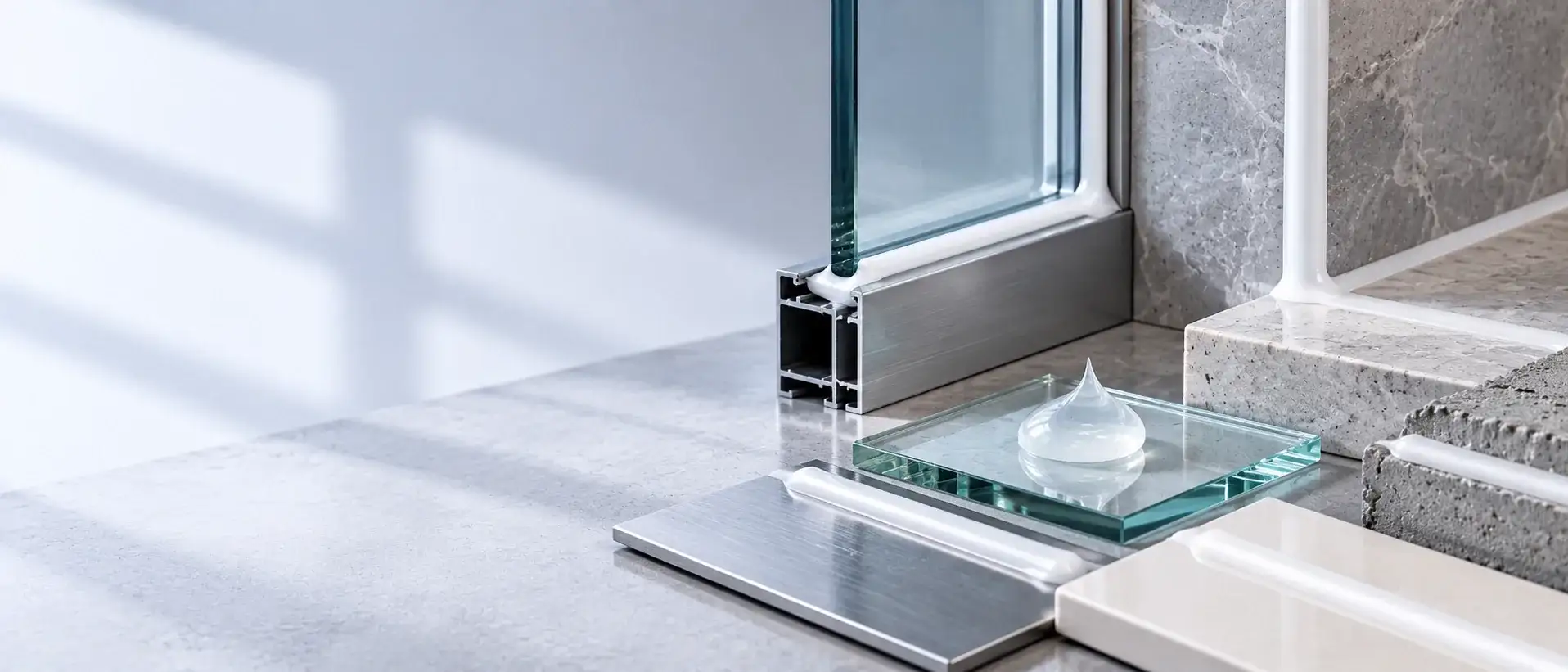
Neutral cure and acetoxy silicone sealants for weatherproofing, glazing, sanitary and general construction sealing — with the substrate, joint design and movement checks that decide which grade fits.
Which cure system do you need?
If the joint touches metal, mirrors, marble, natural stone or concrete, specify neutral cure. Everywhere else — glass-to-glass, glazed ceramic, plain sanitary work — acetoxy cure does the same job faster and costs less.
That one rule settles most enquiries. The reason behind it is what the sealant gives off while it cures: acetoxy silicone releases acetic acid, which corrodes metal, undercuts the reflective backing on mirrors, etches stone and reacts with alkaline concrete. Neutral cure releases nothing corrosive, which is why it is the default specification on almost every construction project.
The same two products go by several names
Specifications and enquiries use these terms interchangeably. If yours uses one of the names on the left, you are asking for the product on the right.
Category-level reference values. Exact figures vary by grade — request the technical data sheet for the product you are evaluating.
What acetoxy silicone can and cannot touch
This table is the whole selection problem in one view. Where acetoxy is marked unsuitable, the failure is not immediate — it appears weeks or months later as corrosion, staining or a bond that lets go, which is why it so often reaches the site before anyone catches it.
Substrate
Neutral
Acetoxy
What goes wrong
Glass
Yes
Yes
—
Glazed ceramic
Yes
Yes
—
Aluminium, copper, brass, galvanised steel
Yes
No
Acetic acid corrodes the metal at the bond line
Mirrors
Yes
No
Attacks the silvered backing — black edges spread inward
Marble, granite, natural stone
Yes
No
Acid etches and stains the surface permanently
Concrete, mortar, cementitious board
Yes
No
Alkaline surface neutralises the acid; the bond never develops
Polycarbonate, acrylic, ABS
Test first
No
Stress cracking; always trial on the actual plastic
Powder-coated and anodised profiles
Yes
Test first
Adhesion depends on the coating, not the metal beneath
Low modulus or high modulus?
Modulus is how hard the cured sealant pushes back as the joint moves. It is a separate question from cure system, and specifications frequently name it — "low modulus neutral cure silicone" is a request for both properties at once.
Class
ISO 11600 designation
Specify it when
Low modulus (LM)
25LM — ≤0.4 MPa secant modulus at 100% elongation
The joint moves a lot, or the substrate is weak — render, lightweight block, thin stone. A soft sealant moves instead of tearing the substrate away.
High modulus (HM)
25HM — >0.4 MPa secant modulus at 100% elongation
The joint carries load or must resist deformation — structural glazing, and anywhere the seal is doing more than keeping water out.
ISO 11600 also carries a use letter: F for façade joints andG for glazing. A full designation therefore reads likeISO 11600 F&G 25LM — a façade and glazing sealant, ±25% movement, low modulus. Ask for the class designation on the technical data sheet rather than the words "low modulus" alone; the letters are what a specifier can check.
Silicone sealant or polyurethane sealant?
A different question again, and one worth answering honestly: silicone is not the right product for every joint. Polyurethane sealant is a separate chemistry with its own advantages, and the two are commonly confused because both arrive in the same cartridge.
Property
Silicone
Polyurethane
Paintable
No — paint will not adhere
Yes
UV and weathering
Excellent, 20+ years
Degrades under prolonged UV unless coated
Abrasion resistance
Low
High
Trafficked horizontal joints
Not suitable
Suitable
Adhesion without primer
Good on glass and metal
Often needs a primer
Temperature range
−40°C to +150°C
−30°C to +80°C
The short version: silicone for glazing, façades and wet areas; polyurethane for joints that need painting or take foot and vehicle traffic. If the joint has to be painted to match the wall, no silicone will do it — that is a polyurethane job. Note that polyurethane sealant is a different product from theone-component PU foamused to fill gaps around openings; the two are frequently confused in enquiries.
Oxime or alkoxy: two different neutral cures
"Neutral cure" covers more than one chemistry. Both common systems release no acetic acid, but they release different things and behave differently, so a specification or a sensitive substrate may need one rather than the other. Ask which system the TDS and SDS name.
System
Releases while curing
Watch for
Oxime
An oxime, commonly MEKO (butanone oxime)
Can discolour or corrode copper and brass; noticeable odour. Its EU hazard classification has tightened, so some European specifications exclude oxime systems
Alkoxy
An alcohol, usually methanol
Lowest odour and no attack on copper or brass; usually cures more slowly, and grades differ in shelf life
Our listed neutral grade is described as oxime/alkoxy at category level; the system for the grade you are quoted is on its SDS.
Neutral cure is not a guarantee for every substrate
Choosing neutral cure removes the acid problem. It does not remove the need to check the sealant against the actual surface, and these are the substrates where that check matters most:
Substrate
Risk
The check
Mirrors
Backing paints vary; some are attacked by components in the sealant
Use a grade the mirror maker approves, or one tested on that backing
Marble, limestone, porous stone
Plasticiser migrates into the stone and leaves a dark band along the joint
A grade tested as non-staining on that stone, for example to ASTM C1248 or ISO 16938
Anodised and powder-coated aluminium
Adhesion depends on the coating, which varies by supplier
Peel-adhesion test on the actual profile; a primer where the TDS calls for one
Polycarbonate and acrylic sheet
Stress cracking in the plastic
Trial on the actual sheet under the stress it will carry
EPDM gaskets, bitumen, setting blocks
Incompatible materials discolour the sealant or lose adhesion
Compatibility test with the accessory materials, for example to ASTM C1087
PE, PP, PTFE
Silicone does not bond to them
Use them as bond breakers, not as bonding surfaces
Painted surfaces
The bond is only as good as the paint
Adhesion test on the finished paint system
Weatherseal or structural: two different jobs
A weatherseal keeps water and air out of a joint and moves with it; if it fails, the building leaks. A structural glazing sealant holds glass to its frame and carries wind load; if it fails, the glass can come away. The second is designed, tested and approved differently: sealants are qualified to standards such as ASTM C1184 or ETAG 002, adhesion and compatibility are tested on the project's own frames, glass and accessories, and approval is normally given project by project, often for two-component products.
The grades we list are weatherseals. If a joint carries load, send the project specification and we will tell you whether we can supply against it rather than offer a weatherseal in its place.
What each figure on a silicone datasheet tells you
Datasheet figures are often read as if they were interchangeable. They are not:
Figure
What it tells you
What it does not
Movement capability (e.g. ±25%)
How far the joint can repeatedly open and close, as a share of its width, in a cyclic test such as ISO 9047 or ASTM C719
Anything about a single stretch to failure
Elongation at break (e.g. ≥400%)
How far a test piece stretches once before it tears
Durability under repeated movement — a high figure does not mean a high movement class
Modulus (ISO 11600 LM / HM)
How hard the cured sealant pulls on the joint edges as it stretches
Adhesion — a low-modulus sealant still needs a sound, clean substrate
Shore A hardness
Surface softness of the cured rubber
Modulus or movement capability; it correlates only loosely with either
Tensile strength
The strength of the rubber itself
The bond to the substrate, which is tested separately, for example by peel adhesion to ASTM C794
Skin time and cure rate
When the surface can be touched, and how fast cure proceeds inward
When the joint can take movement — a 10 mm deep joint cures in days, not minutes
Joint design: width, depth and what goes behind the sealant
—Size the width from the movement. The joint must be wide enough that the expected movement stays within the sealant's movement capability. As an illustration: 5 mm of expected movement with a ±25% sealant needs a joint at least 20 mm wide (5 ÷ 0.25).
—Keep the depth shallower than the width. Common guidance puts depth at about half the width, within the minimum and maximum dimensions on the sealant's TDS. A deep, narrow bead cannot stretch and cures slowly.
—Use a backer rod to set the depth. Closed-cell polyethylene rod, slightly wider than the joint, controls depth and gives the sealant an hourglass profile that moves well.
—Bond to two sides, never three. Sealant stuck to the back of the joint cannot stretch and tears. Where there is no room for a rod, use bond-breaker tape on the back face.
—Allow for cure depth. One-component silicone cures from the surface inward, roughly 2–3 mm per day at 23°C and 50% RH, so do not load or cover a deep joint on day one.
Troubleshooting silicone joints
Symptom
Likely cause
Check first
Stays soft or tacky
Expired or heat-damaged cartridges, very dry air, a section too deep, or contact with an incompatible material
Batch date and storage; joint depth; what the sealant touches
Tears down the middle
Movement beyond the sealant’s capability, joint too narrow, or three-sided adhesion
Joint width against expected movement; backer rod or bond breaker
Peels from one edge
Dust, moisture, release agent or old sealant on the surface; a coating that needs primer; bead not tooled into contact
Surface cleaning and priming against the TDS
Dark band on stone
Plasticiser migration into porous stone
Switch to a grade tested non-staining on that stone
Black edges spreading on a mirror
Acetoxy or an incompatible grade attacking the backing
Mirror-compatible neutral grade
Discoloured or yellowed sealant
Contact with incompatible gaskets or bitumen, cleaning chemicals, or dirt pick-up
Compatibility of adjacent materials
Corrosion at a metal edge
Acetoxy sealant on metal
Neutral cure for any joint touching metal
Mould in a wet-area joint
Grade without fungicide, standing water, or mould left behind old sealant
Mould-resistant grade; full removal and cleaning before resealing
When you ask us to match a grade, tell us the joint use, the substrates on both sides and their finish, joint width and depth, expected movement, indoor or outdoor, and the class your specification names (for example ISO 11600 F 25LM or ASTM C920).
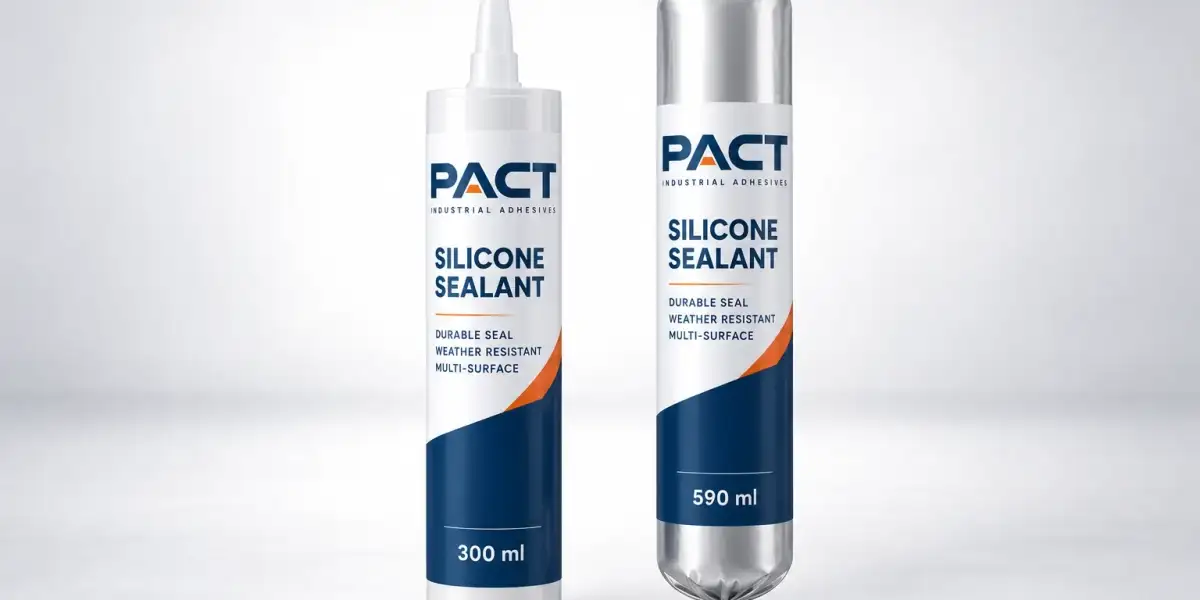
300 ml cartridge and 590 ml foil sausage
What Is Silicone Sealant?
Silicone sealant is an elastomeric sealing compound based on polydimethylsiloxane (PDMS) polymer — a silicone-based material that cures at room temperature to form a flexible, waterproof, and weather-resistant rubber seal. Unlike organic sealants (polyurethane, acrylic, or butyl), silicone sealant maintains its properties across an exceptionally wide temperature range (-40°C to +150°C for standard grades, up to +250°C for high-temperature formulations), resists UV degradation for 20+ years, and does not shrink, crack, or harden over time. These characteristics make silicone sealant the preferred sealing material for construction, glazing, automotive, and industrial applications worldwide.
The curing mechanism of silicone sealant is moisture-activated: the sealant reacts with atmospheric humidity to crosslink from the outside surface inward, forming a durable elastomeric rubber. Skin formation (surface tack-free time) typically occurs within 10-20 minutes, while full depth cure proceeds at approximately 2-3 mm per 24 hours. The curing chemistry determines the sealant classification — neutral cure or acetoxy cure — each with distinct performance characteristics and substrate compatibility.
How each cure system works
The tables above are the decision. This is the chemistry underneath them, for anyone who has to justify the choice to a specifier or a customer.
Neutral cure silicone uses an oxime or alkoxy crosslinking system that releases non-corrosive byproducts during curing. This is the critical difference from acetoxy silicone: neutral sealant will not corrode metals (copper, brass, aluminum, galvanized steel), will not damage mirrors (no black-edge effect), will not stain or etch marble and natural stone, and will not react adversely with concrete and cementitious substrates. For these reasons, neutral silicone sealant is the default specification for most construction and industrial sealing applications. PACT's neutral silicone sealant achieves tensile strength of ≥0.8 MPa, elongation at break of ≥400%, and movement capability of ±25%, meeting ASTM C920 and EN 15651 standards.
Acetoxy Cure Silicone Sealant
Acetoxy silicone sealant releases acetic acid during curing — identifiable by the strong vinegar smell. Acetoxy sealant cures faster than neutral (skin formation in 5-10 minutes vs. 10-20 minutes) and is generally less expensive to manufacture, making it a cost-effective choice for applications where its limitations are not a concern. Acetoxy sealant bonds well to glass, glazed ceramics, and non-porous surfaces, and is commonly used for aquarium sealing, glass-to-glass bonding, and simple bathroom sealing on non-metallic substrates. However, it must never be used on metals (causes corrosion), mirrors (dissolves reflective coating), marble or natural stone (acid etching), or concrete (reacts with alkaline surface).
Silicone Sealant Application Areas
Silicone sealant serves essential sealing functions across the construction and building maintenance sectors:
—Structural glazing and curtain wall: Structural silicone sealant bonds glass panels to aluminum frames in curtain wall systems, transferring wind loads and seismic forces through the adhesive joint. This is the most demanding silicone sealant application and uses sealants approved for structural use, project by project — not the weatherproofing grades we list (see weatherseal or structural).
—Window and door perimeter sealing: Weatherproof sealant creates an air-tight and water-tight seal between window/door frames and the surrounding wall opening, preventing water infiltration, air leakage, and energy loss.
—Expansion and movement joints: Buildings expand and contract with temperature changes. Silicone sealant's ±25% movement capability accommodates this thermal movement without bond failure or sealant tearing, maintaining the watertight seal over the building's lifetime.
—Sanitary and wet-area sealing: Mildew-resistant silicone sealant (containing fungicide additives) seals joints in bathrooms, kitchens, shower enclosures, and swimming pools. The sealant's inherent water resistance and anti-mold formulation prevent black mold growth in damp environments.
—General construction sealing: Pipe penetrations, cable entries, HVAC duct joints, roofing details, and cladding panel joints all require durable, flexible sealant that withstands weathering and building movement.
Color Options and Custom Matching
PACT produces silicone sealant in white, clear/transparent, black, grey, brown, and almond as standard stock colors. For projects requiring specific color integration with facade materials, window frames, or interior finishes, we offer custom RAL color matching with a minimum order of 3,000 cartridges. Custom color samples are produced and shipped for client approval before bulk production begins. Color pigments are UV-stable to resist fading over the sealant's service life.
PACT Sealant Production Capability
Our sealant production facility in Guangzhou features automated cartridge filling lines, planetary mixer systems for consistent batch-to-batch quality, and in-house testing laboratories for quality verification. Every production batch is tested for application properties (skin time, extrusion rate, sag resistance), mechanical properties (tensile strength, elongation, hardness), and adhesion to standard substrates (glass, aluminum, concrete, ceramic). We produce silicone sealant in 280ml and 300ml cartridges (compatible with standard caulking guns), 590ml sausage packs, and 20L pails. Full OEM and private label services are available, including custom cartridge labels, branded carton packaging, and technical documentation in your required languages.
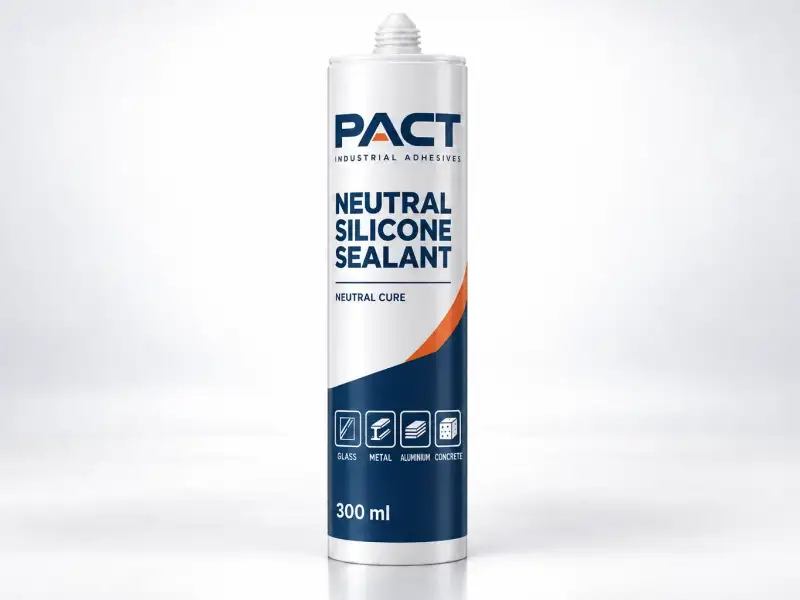
Neutral cure (oxime/alkoxy) silicone sealant suitable for a wide range of construction and industrial applications. Releases no acetic acid, so it does not corrode metals the way acetoxy does; mirror, stone and structural joints need a grade confirmed for that use.
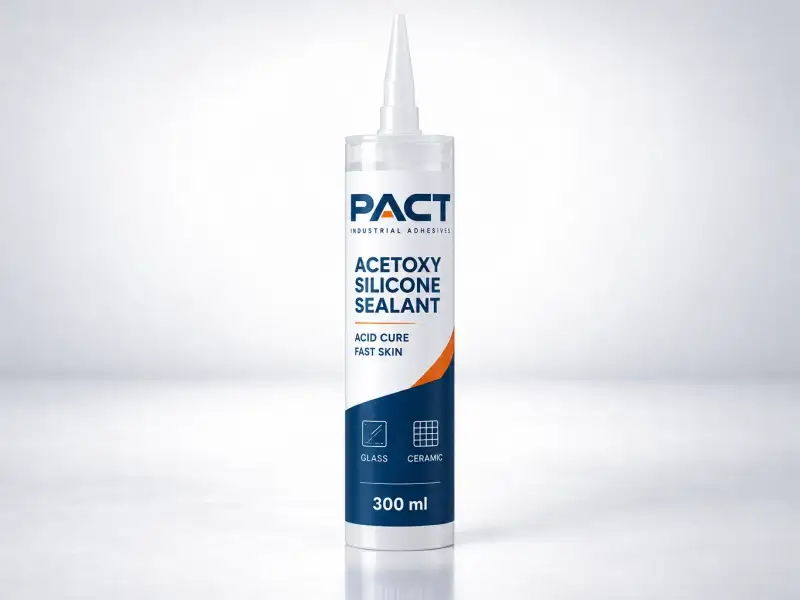
Fast-curing acetoxy (acetic cure) silicone sealant for glass, glazing and sanitary work. Highest tack and quickest skin-over of any silicone chemistry, at the cost of substrate compatibility.
Acetoxy silicone is a sealant that cures by reacting with atmospheric moisture and releasing acetic acid — the vinegar smell you notice while it sets. It is also sold as acetic silicone, acid cure silicone or acetoxysilane cure. It skins in 5-10 minutes, costs less than neutral cure, and bonds well to glass and glazed ceramic. Because of the acid it must not be used on metal, mirrors, marble, natural stone or concrete.
What is non-acetic, non-acid or non-acetoxy silicone?
All three names describe the same thing: neutral cure silicone sealant. It uses an oxime or alkoxy crosslinking system that releases no acetic acid, so it does not corrode metal or etch marble and concrete the way acetoxy does. Mirror backings and porous natural stone still need a grade confirmed compatible with them — neutral describes the cure chemistry, not a guarantee for every substrate. If a specification asks for non-acid or non-acetoxy silicone, neutral cure is what it wants.
What does low modulus neutral cure silicone mean?
It names two properties at once. Neutral cure is the chemistry — no acetic acid released. Low modulus (ISO 11600 class 25LM, at most 0.4 MPa secant modulus at 100% elongation) means the cured sealant stays soft, so a moving joint stretches the sealant rather than pulling the substrate apart. Specify it for wide movement joints and for weak substrates such as render, lightweight block or thin stone. Ask for the ISO 11600 class on the technical data sheet rather than the words alone.
What is the difference between silicone sealant and polyurethane sealant?
Silicone resists UV and weathering for 20+ years and works from -40°C to +150°C, but cannot be painted and has poor abrasion resistance. Polyurethane sealant can be painted and withstands foot and vehicle traffic, but degrades under prolonged UV unless coated and normally needs a primer. Use silicone for glazing, facades and wet areas; use polyurethane where the joint must be painted or trafficked. Polyurethane sealant is also a different product from one-component PU foam, which fills gaps around door and window openings.
What is the difference between neutral and acetoxy silicone sealant?
Neutral cure silicone sealant releases no acetic acid while it cures, so it does not corrode metals or react with concrete and marble the way acetoxy does. Neutral describes the curing chemistry, though: mirror backings, natural stone and structural applications still need a grade and test evidence suitable for that specific use. Acetoxy silicone releases acetic acid (vinegar smell) and cures faster, but is not suitable for metal or alkaline substrates. Neutral is preferred for most construction applications.
What silicone sealant packaging options do you offer?
We offer silicone sealant in 280ml and 300ml cartridges (standard construction size), 590ml sausage packs for high-volume application, 20L pails for industrial use, and custom sizes for OEM orders. Cartridges are compatible with standard caulking guns.
Can your silicone sealant withstand extreme temperatures?
Our standard silicone sealants perform in the range of -40°C to +150°C. High-temperature formulations withstand up to +250°C. The sealant maintains elasticity and adhesion across this range, making it suitable for both tropical and cold-climate construction projects.
Do you provide color-matched silicone sealant?
Yes, we produce silicone sealant in white, clear/transparent, black, grey, brown, and custom RAL colors. Custom color matching is available with a minimum order of 3,000 cartridges. We provide color samples for approval before bulk production.
Substrate, volume and destination market are enough for us to price it.
Need a Custom Silicone Sealant Formulation?
Send the joint use, substrates, joint size and the class your specification names, and we will match a weatherproofing or sanitary grade — or tell you plainly when the job needs a structural glazing sealant we do not list.