
Technical reference
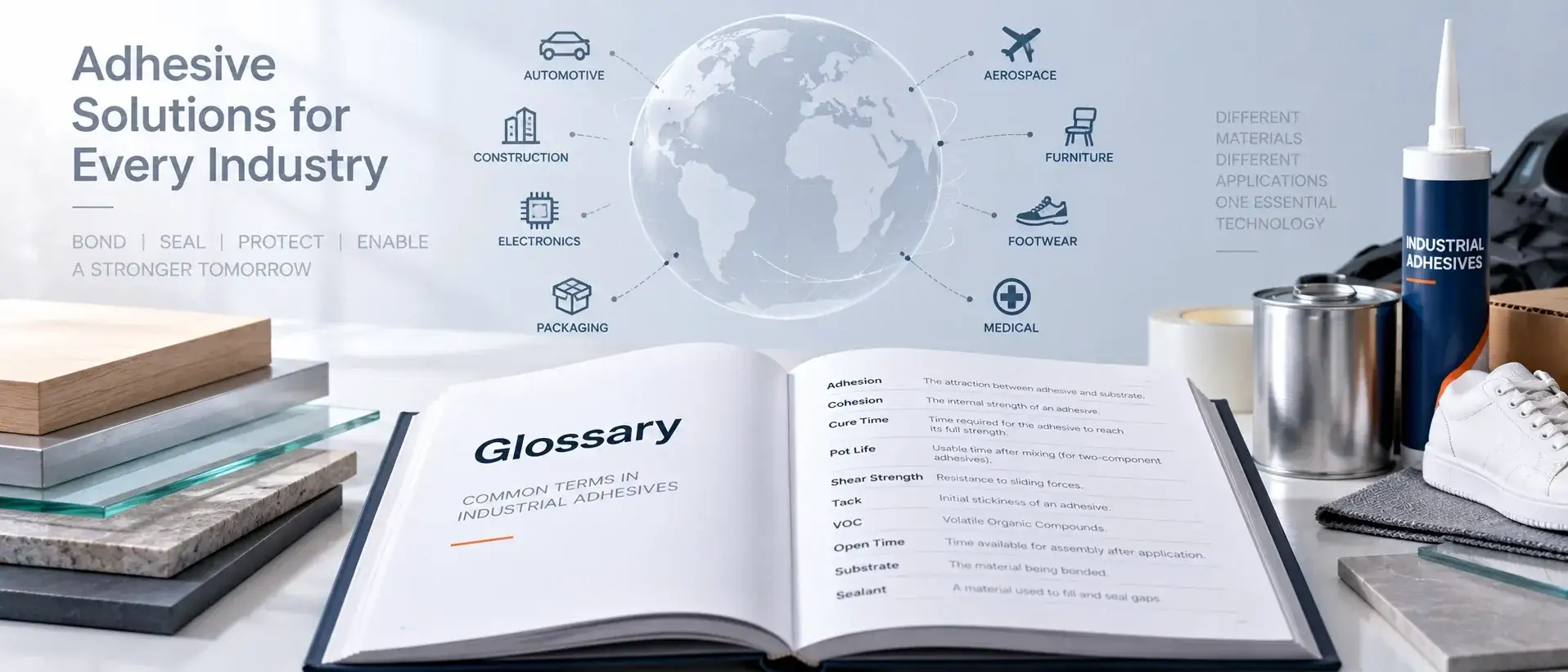
Adhesive & Sealant Glossary
67 terms, of which 49 carry a second, third or fifth name depending on the market you are buying in. Where a term has other names, they are listed first — that is usually the question.
Last updated: 2026-09-16
Why the same product has five names
Three habits collide in this trade. Brand names became category words — Liquid Nails for construction adhesive, Neoprene for chloroprene rubber. Regions kept their own trade terms, so a British specification says grab adhesive where an American one says liquid nails. And specifications frequently name a product by what it is not: non-acid, non-acetoxy, nail-free, solvent-free.
The result is buyers and suppliers describing the same drum in words that do not obviously match, which costs a round of email at best and the wrong product at worst. This page is the translation.
- Acetoxy cure Chemistry
Also called: Acetic silicone · Acid cure silicone · Acetoxysilane cure · Vinegar silicone
A silicone sealant that cures by reacting with atmospheric moisture and releasing acetic acid — the vinegar smell while it sets.
Faster and cheaper than neutral cure, but the acid corrodes metal, attacks mirror backing, etches stone and reacts with concrete. Those four exclusions decide most sealant selections.
- Adhesive failure Property
A bond failure at the interface — the adhesive has separated cleanly from one substrate, leaving it bare.
Diagnostic: this is a wetting or surface preparation problem, not usually a product problem. Look at contamination, roughing and primer before changing adhesive.
- BTX Compliance
Also called: Three benzenes · Benzene, toluene, xylene · 三苯
Benzene, toluene and xylene — the aromatic solvents contact adhesives were traditionally built on, and the substances a "benzene-free" claim is about.
All three are liquids at room temperature. Industrial "mixed benzene" and aromatic solvent naphthas belong to the same family, so a product made with them is not BTX-free.
- Buffing Process
Also called: Roughing · Abrading
Mechanically abrading a bonding surface to break the glaze and give the adhesive something to key into.
Skipping it is the single most common cause of adhesive failure in footwear and rubber bonding.
- Chloroprene rubber Chemistry
Also called: CR · Neoprene · Polychloroprene
A synthetic rubber whose chlorinated backbone gives it heat resistance to around +120°C and good resistance to oils and solvents.
"Neoprene" was a DuPont trade name that became the generic word for the polymer.
- Class 3 Trade
Also called: Flammable liquid
The dangerous-goods class for flammable liquids, which covers any adhesive with a flash point below 23°C.
- COA Trade
Also called: Certificate of analysis
A document certifying the tested properties of the specific batch shipped, as distinct from the typical values on a TDS.
A TDS describes the product; a COA describes your drum. Ask for the COA when the specification matters.
- Coat weight Property
Also called: Coating weight · Glue spread · Spread rate
The amount of adhesive applied per area, in g/m², stated wet or dry.
Dry coat weight is roughly wet coat weight multiplied by the solids fraction. Performance figures only mean something at the coat weight they were measured at.
- Cohesive failure Property
A bond failure within the adhesive layer itself — material remains on both substrates.
Diagnostic: the adhesive was the weakest link, so the product genuinely is under-specified for the load. This is the failure mode that justifies changing grade.
- Construction adhesive Product type
Also called: Liquid nails · Grab adhesive · No More Nails · Nail-free adhesive · Panel adhesive · Mounting adhesive
A high-grab, gap-filling adhesive applied from a cartridge to replace mechanical fixings.
"Liquid Nails" is a North American brand name that became the category word, the way Hoover did for vacuum cleaners. UK and Australian trades usually say grab adhesive.
- Contact adhesive Product type
Also called: Contact cement · Impact adhesive
An adhesive applied to both surfaces, left to flash off until touch-dry and tacky, then mated. The bond forms on contact with no clamping.
The defining property is that it does not allow repositioning. One shot at alignment.
- Creep Property
Slow deformation of a bond under sustained load, particularly at elevated temperature.
Why a bond that passes a short-term test can still sag over a summer. Ask for performance after ageing, not just initial values.
- DIN 75201 Compliance
Also called: Fogging test
The automotive test for fogging — condensation of volatiles from interior materials onto the windscreen.
- EN 1392 Compliance
The European standard that specifies how the bond strength of solvent-based and dispersion adhesives for leather and footwear materials is tested under specified conditions.
It is a test method, not a pass mark and not a flex-durability test. Two figures quoted against it are comparable only when the conditioning, substrates and surface preparation also match.
- Exempt compound Compliance
A solvent excluded from the VOC calculation under US EPA 40 CFR 51.100(s) because it contributes negligibly to ozone formation — acetone, methyl acetate, PCBTF and others.
A regulatory status, not a safety claim: acetone is exempt and more flammable than the toluene it might replace. The US list is not China's: GB 33372-2020 deducts only acetone, methyl acetate and dimethyl carbonate for solvent-based adhesives.
- Flash point Property
The lowest temperature at which a liquid gives off enough vapour to ignite.
Below 23°C makes the product a Class 3 flammable liquid, which decides how it ships, stores and insures. Solvent-borne adhesives are typically ≤−4°C.
- Flash-off Process
Also called: Flash-off time · Solvent release
The period after application during which solvent evaporates from the wet film, before open time begins.
Mating during flash-off traps solvent in the bond line, which is one of the two classic timing failures. The other is mating after tack has gone.
- FOB Trade
Also called: Free on board
An Incoterm where the seller delivers goods on board the vessel at the named port and risk transfers there.
FOB is not comparable with a local supplier’s delivered price. Ask for CIF or DDP if you want a number you can compare directly.
- Free formaldehyde Compliance
Also called: 游离甲醛
Formaldehyde present in an adhesive that is not chemically bound, measured as a content limit in standards such as GB 18583.
Polychloroprene adhesives often use alkylphenol-formaldehyde tackifying resins, so a formaldehyde-free claim needs a measured result rather than a label.
- GB 18583 Compliance
Chinese standard limiting harmful substances in adhesives for interior decoration — for solvent-based adhesives including free formaldehyde, benzene, toluene plus xylene, halogenated hydrocarbons and total VOC.
A pass means measured values under the limits, not absence. VOC content limits by adhesive type are set separately in GB 33372-2020.
- GB 33372-2020 Compliance
The mandatory Chinese national standard setting VOC content limits for adhesives.
Limits depend on carrier (solvent-based, water-based or bulk), polymer type and application field together, and the bulk table is in g/kg rather than g/L. For solvent-based adhesives it deducts only acetone, methyl acetate and dimethyl carbonate, not the full US exempt list.
- Green strength Property
Also called: Initial grab · Handling strength
The strength a bond has immediately after assembly, before cure is complete.
Frequently confused with final strength. High green strength means the part can be handled; it says nothing about what the joint will hold in a week.
- Halogenated hydrocarbon Compliance
Also called: Chlorinated solvent · 卤代烃
Solvents containing chlorine or other halogens, such as methylene chloride. Strong and non-flammable, but restricted in many markets and limited separately in adhesive standards.
Sometimes used to replace aromatics in adhesives sold as benzene-free.
- Hardener Chemistry
Also called: Crosslinker · Curing agent · Activator
A second component mixed into an adhesive before use to raise heat, water or hydrolysis resistance.
Once mixed the adhesive has a pot life, and what is left at the end of it is discarded, not thinned and reused.
- Holding power Property
Also called: Static shear · Shear adhesion
How long a pressure-sensitive adhesive holds a static load without sliding, reported as time to failure under a stated load and temperature.
- IMDG Trade
Also called: International Maritime Dangerous Goods Code
The code governing carriage of dangerous goods by sea, and the declaration your shipment needs to travel under it.
- ISO 11600 Compliance
The classification standard for building sealants, combining a use letter (F for façade, G for glazing), a movement class and a modulus designation.
A full designation reads like ISO 11600 F&G 25LM. Ask for the class rather than the words "low modulus" — the letters are what a specifier can check.
- Lasting Process
Pulling the shoe upper over the last and securing it to the insole, before the outsole is attached.
- Low modulus Property
Also called: LM · 25LM
A sealant that stays soft under extension — at most 0.4 MPa secant modulus at 100% elongation under ISO 11600.
Specify it for wide movement joints and weak substrates such as render or thin stone, where a stiff sealant tears the substrate away instead of stretching.
- Minimum film-forming temperature Property
Also called: MFFT · MFT · White point
The lowest temperature at which a water-based dispersion dries into a continuous film.
Below it the glue dries white and powdery with little strength — a winter workshop problem, not a bad batch.
- MOQ Trade
Also called: Minimum order quantity
The smallest quantity a supplier will produce or sell of a given grade and pack format.
A very low MOQ from a supplier who cannot describe their production usually means stock from someone else’s inventory.
- Movement capability Property
How much a sealed joint can change in width, as a percentage, without the seal failing. Basis of the ISO 11600 class.
Does not rescue a badly proportioned joint — depth-to-width ratio matters as much as the figure.
- Neutral cure Chemistry
Also called: Non-acetic silicone · Non-acid silicone · Non-acetoxy silicone · Oxime cure · Alkoxy cure
A silicone sealant using an oxime or alkoxy crosslinking system, which releases no acetic acid as it cures.
If a specification asks for non-acid or non-acetoxy silicone, neutral cure is what it wants. The negative names are more common in specifications than the positive one.
- Not detected Compliance
Also called: ND · Below detection limit · 未检出
A test result below the detection limit of the stated method. It is not the same as zero, and it means nothing without the method and the limit.
Also distinct from "not intentionally added", which is a formulation declaration, and "within the limit", which can be well above zero.
- OEM / ODM Trade
OEM: manufacturing to the buyer’s specification. ODM: the manufacturer’s own design, supplied under the buyer’s brand.
Used loosely and often interchangeably in this trade. Establish which one a quotation actually describes.
- Open time Property
Also called: Assembly time · Working time
The window after application during which the film is touch-dry and tacky and the parts can still be brought together.
Measured at 23°C and 50% RH. Warm dry air shortens it; cold humid air lengthens it and can blush a solvent-borne film white.
- PDMS Chemistry
Also called: Polydimethylsiloxane · Silicone
The silicon-oxygen backbone polymer behind silicone sealant. Not an organic polymer, which is why it behaves nothing like the others.
Indifferent to UV, weather and temperature; cannot be painted, and nothing adheres to cured silicone including fresh silicone.
- Peel strength Property
Also called: Bond strength (peel) · 180° peel
Force per millimetre of bond width required to peel one adherend back off the other. Quoted in N/mm.
Not comparable between suppliers without the substrate pair and the test standard. The most over-weighted figure in adhesive selection.
- Polyurethane dispersion Chemistry
Also called: PUD · Waterborne polyurethane · Water-based PU
Polyurethane carried in water, used for footwear, textile lamination and vacuum membrane pressing, usually heat-activated and often crosslinked.
- Polyvinyl acetate Chemistry
Also called: PVAc · PVA glue · White glue · Wood glue
A water-based dispersion that sets as the water is absorbed and evaporates, forming a tough film. The standard wood assembly and veneering adhesive.
PVA is also the abbreviation for polyvinyl alcohol, a different material — write polyvinyl acetate in full on a purchase order.
- Pot life Process
Also called: Working life
How long a mixed two-component adhesive stays usable before it thickens or loses performance.
Not the same as open time, which runs from application to joining.
- Pressure-sensitive adhesive Product type
Also called: PSA · Self-adhesive
An adhesive that stays permanently tacky and bonds under light pressure, with no heat, water or solvent needed to activate it. Labels, tapes and protective films use it.
Specified by tack, peel and holding power together, each with its test method.
- Primer Product type
A pre-treatment applied to a substrate to improve adhesion, matched to the substrate rather than to the adhesive.
In footwear the primer is matched to the outsole material — TPR, rubber, EVA and PU each take a different one. Using the wrong primer looks like an adhesive failure.
- Private label Trade
Also called: White label · Own brand
An existing formulation supplied under the buyer’s brand, with their label, cartons and packaging.
Distinct from custom formulation, where the chemistry itself is developed for you. Private label normally follows the standard MOQ of the product chosen.
- PU foam Product type
Also called: Expanding foam · Gap filler · One-component foam · OCF
A moisture-cured polyurethane dispensed from an aerosol can, expanding to fill and insulate a gap.
A different product from polyurethane sealant, which they are often confused with in enquiries.
- REACH Compliance
Also called: EC 1907/2006 · SVHC declaration
The EU regulation on chemical substances. Restricts specific substances of very high concern rather than setting a total VOC limit.
An SVHC declaration is what an EU importer normally asks for. It answers a different question from a VOC figure.
- Reactivation Process
Also called: Heat activation
Heating a dried cement film until it becomes tacky again, immediately before mating. Standard in footwear at 60-75°C.
An oven running a few degrees cold is one of the most common causes of sole separation.
- SBS Chemistry
Also called: Styrene-butadiene-styrene · Styrene block copolymer
A thermoplastic block copolymer: rubbery butadiene segments anchored by rigid styrene domains.
The styrene domains soften with heat, which is why SBS adhesive gives up around +70°C where chloroprene holds to +120°C.
- SCAQMD Rule 1168 Compliance
The South Coast Air Quality Management District rule setting VOC limits for adhesives and sealants in Southern California.
The most widely cited adhesive VOC rule in the world, frequently written into private specifications and LEED credits far outside California. Limits are stated less water and less exempt compounds.
- SDS Trade
Also called: MSDS · Safety data sheet
The hazard, handling and emergency document required for a chemical product, in the language of the destination market.
- Sealant Product type
Also called: Caulk · Mastic
A material that fills and seals a joint while accommodating movement, rather than structurally bonding two parts together.
The three words are used interchangeably in trade, but sealant normally implies a higher-performance elastomeric product, and caulk a lower-cost decorative one.
- Shear strength Property
Force per unit area required to slide two bonded surfaces across each other. Quoted in MPa or N/mm².
Always looks larger than a peel figure for the same product because it is a less demanding failure mode. Compare peel with peel.
- SMP Chemistry
Also called: Silyl modified polymer · MS polymer · Hybrid polymer
A polymer backbone terminated with silane groups, curing by moisture like a silicone but bonding and painting like a polyurethane.
Common in modern construction adhesives, where paintability and adhesion both matter.
- Sole attach Process
Also called: Sole bonding
Bonding the outsole to the lasted upper — the highest-peel joint in a shoe.
- Solids content Property
Also called: Solid content · Non-volatile content · NVC
The share of the product remaining after the carrier evaporates — the part that becomes the bond.
Solvent-borne contact adhesive runs 18-25%, so roughly three quarters of what you pay freight on leaves. Compare quotations per kilogram of solids, not per kilogram of product.
- Substrate Process
Also called: Adherend
The material being bonded. Adherend is the more precise term for each of the two parts in a joint.
- Tack Property
Also called: Loop tack · Quick stick · Initial tack
How readily an adhesive grabs a surface on light, brief contact.
For pressure-sensitive adhesives measured as loop tack (FINAT FTM 9, PSTC-16, ASTM D6195); only comparable on the same method and test surface.
- Tackifier Chemistry
Also called: Tackifying resin
A resin added to raise initial grab and extend open time. It does not form the bond — the base polymer does.
Tackifier substitution is one of the quiet ways a formulation gets cheaper without the label changing. Worth asking a supplier to commit to notifying you.
- TDS Trade
Also called: Technical data sheet
The document stating a grade’s properties, application method and storage conditions.
Ask for the TDS of the exact grade quoted, not of the product family.
- Two-component Chemistry
Also called: 2K · 2-part · Two-part
An adhesive supplied as a base plus a hardener or crosslinker, mixed immediately before use.
Higher performance and higher solids, at the cost of pot life — once mixed the clock runs whether you use it or not.
- UN 1133 Trade
The UN number for adhesives containing flammable liquid — the classification most solvent-borne adhesives ship under.
Brings dangerous-goods packaging certification, an IMDG declaration, consolidation restrictions and carrier surcharges with it.
- UN 1950 Trade
The UN number for aerosols, applied regardless of what the can contains.
Spray adhesive and PU foam both ship under it.
- VAE Chemistry
Also called: Vinyl acetate–ethylene · EVA emulsion
A vinyl acetate–ethylene copolymer dispersion giving a more flexible film than PVAc, used in paper, packaging and foil lamination.
Unrelated in use to EVA hot melt despite the similar monomers. Sold both as raw dispersion and as finished adhesive.
- VDA 278 Compliance
Thermal desorption analysis measuring VOC and FOG emissions from automotive interior materials.
Interior programmes test what comes out into the cabin, not what is in the tin — a stricter and different question from a VOC content limit.
- Viscosity Property
Also called: mPa·s · Centipoise · cP
Resistance to flow. Millipascal-seconds and centipoise are numerically identical: 3,000 mPa·s is 3,000 cP.
Water is about 1, honey around 10,000. Temperature dependent — a figure quoted at 25°C does not describe a drum in a cold warehouse.
- VOC Compliance
Also called: Volatile organic compound
Organic compounds that evaporate at ambient temperature and contribute to ground-level ozone formation.
A VOC figure means nothing without the governing rule, the product category within it, and the basis — with or without water and exempt compounds.
- Water-based adhesive Product type
Also called: Waterborne adhesive · Aqueous dispersion · Latex adhesive
Polymer dispersed in water rather than dissolved in solvent, coalescing into a film as the water leaves.
Water-based describes the carrier, not the polymer, and is not the same claim as low VOC or low emission. Usually not a flammable liquid or dangerous goods — confirm from the SDS. Must never be allowed to freeze.
A
B
C
D
E
F
G
H
I
L
M
N
O
P
R
S
T
U
V
W
Where the terms come from
- What the base polymer actually decides
Chloroprene, SBS, PU, water-based and silicone — heat, flex and durability are set the moment the family is chosen.
- How to read the numbers on a datasheet
What each figure predicts, what it does not, and why one without its test method is not comparable.
- Neutral, acetoxy and the negative names
Non-acid, non-acetic and non-acetoxy all describe the same cure system.
- Liquid nails, grab adhesive, no more nails
One product category, six market names, and which grade suits which job.
- Check the VOC limit for your destination market
Which instrument actually governs adhesives in the US, EU and China — and which ones are wrongly cited.
- Storage, shelf life and what heat does to it
Why a container crossing the tropics at 60-70°C is the hardest storage condition your adhesive will see.
- Eight checks before you pick a supplier
Manufacturer or trader, grade-level test data, VOC position and dangerous-goods handling — apply them to us too.
- Browse the full technical library
Every reference page and guide, grouped by the question it answers rather than by date.
- Put your own brand on it — OEM and ODM
Custom labels, cartons and formulation adjustments from our existing lines.
- Send a specification and get a quote
Substrate, volume and destination market are enough for us to price it.

A term we have missed?
If a word in your specification is not here, send it. We would rather add the entry than have you order the wrong product because two suppliers called the same thing different names.