
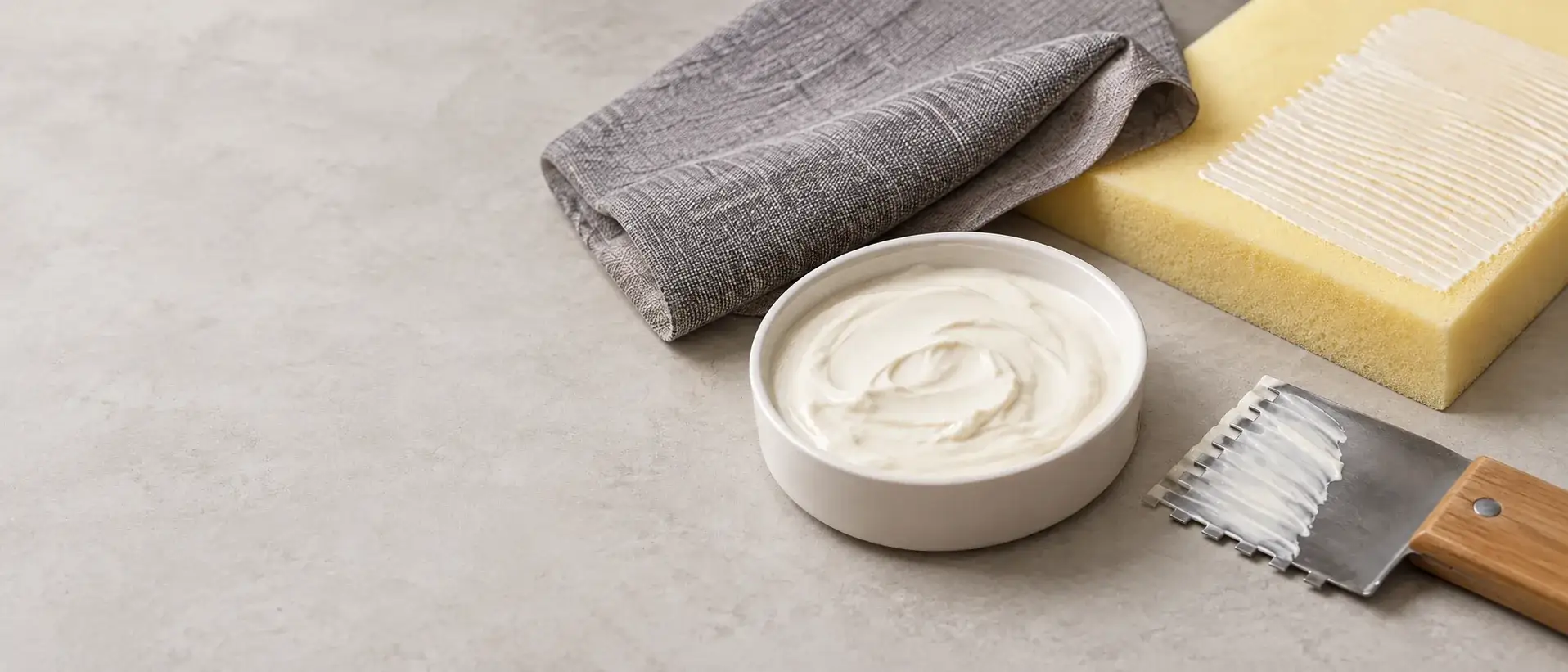
Water-Based Foam & Upholstery Adhesives
Water-based adhesives bond foam to foam and foam to fabric in mattress and upholstered furniture production without the solvent vapour of conventional spray glue. They change the process as well as the product — spray equipment, drying and glue-line feel all need checking — so start from your foam, your line and how the finished product is judged.
An application we assess on request. Share your substrates, process and target requirements and we will confirm suitability, available documentation and sourcing feasibility — no stock grade is listed yet.
Discuss Your Application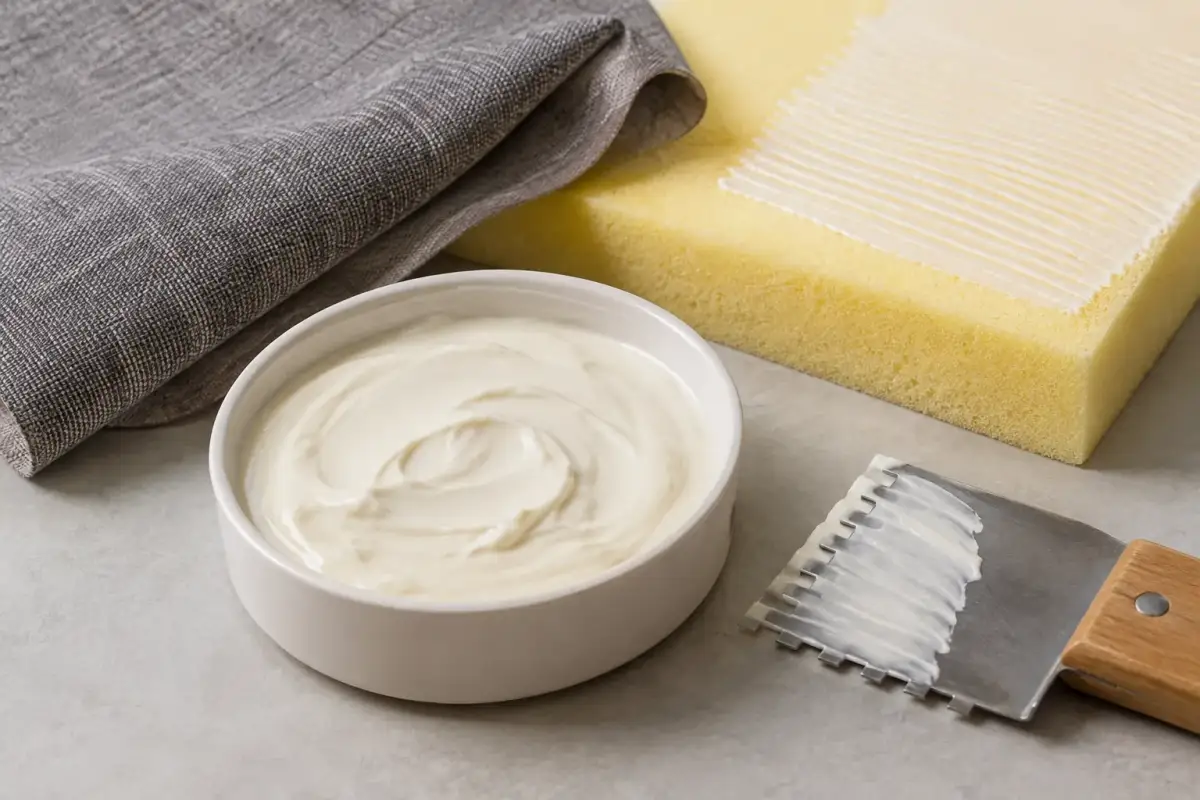
Foam-to-Foam, Foam-to-Fabric and Foam-to-Board
- —Foam to foam: layering mattress and cushion cores. Coverage can be partial; what matters is that the bond survives repeated compression without the layers shearing apart.
- —Foam to fabric: wrapping and covering. The fabric must not show strike-through, and the glue line must not be felt through it.
- —Foam to board: fixing foam to frames and bases. This carries more load at the edges, and a board face does not absorb water, so drying before contact matters more.
Acrylic, Polychloroprene and PU Dispersions
| Chemistry | Where it helps | What to watch |
|---|---|---|
| Acrylic dispersion | Soft, flexible glue line; bonds well to fabrics | Grab develops more slowly, so parts may need longer before handling |
| Polychloroprene dispersion | Contact-style grab closest in handling to solvent spray glue | Often sprayed with a separate activator so the dispersion breaks and grabs at once — which needs a two-feed gun |
| Polyurethane dispersion | Flexible bonds with better heat resistance | Usually needs more drying or heat, and costs more per kilogram |
Single- and Two-Component Spraying
A single-component water-based adhesive is sprayed like any bulk glue, then left until enough water has gone for the surfaces to grab. It needs no special gun, but it needs time, and that time grows in humid air.
A two-component system sprays the dispersion together with an activator that makes it grab immediately, so parts can be joined straight away. The cost is a gun that feeds both parts, ratio control, and more careful cleaning — an activator left in the line sets the adhesive where you do not want it.
Spray Equipment
- —Wetted parts — pumps, pots, hoses and tips — must not corrode in water; stainless steel or suitable plastics are the usual choice.
- —Clean out solvent glue completely before switching; residues can make a dispersion coagulate in the line.
- —Clean guns before the adhesive dries in them. Dried dispersion does not redissolve in water the way wet adhesive washes out.
- —Protect drums and lines from freezing; many dispersions are damaged permanently by it. See the storage guide.
Drying, Initial Tack and Line Speed
Solvent evaporates quickly; water does not, and humid air slows it further. Open-cell foam helps by drawing some of the water in, but a foam-to-board or fabric-to-coated-fabric joint has nowhere for it to go. Closing a joint before the adhesive is ready gives weak initial grab and can trap water between layers. Measure grab at the point your operators handle the part, and again after full drying, on your own foams.
What to Tell Us
| Parameter | Why it matters | What to tell us |
|---|---|---|
| Foam type and density | Open-cell and low-density foams absorb the water phase; rebonded foam absorbs most of all. | Foam grade names or densities |
| Second material | Fabric, foam and board each need a different bond line and coverage. | Fabric type, board material |
| Spray equipment | Decides whether single- or two-component systems are practical, and whether wetted parts suit a water-based product. | Gun, pump or pressure pot, and their materials |
| Time between spraying and assembly | Single-component water-based adhesive needs drying before contact; two-component systems grab at once. | Seconds or minutes available on your line |
| Glue-line feel | A hard line under the fabric is a common reason finished cushions are rejected. | How the finished product is judged |
| Workshop temperature and humidity | Humid air slows drying; cold stores can freeze the adhesive. | Range through the year |
| Certification or brand requirement | Certifications apply to the foam or the finished product; they set what documentation the adhesive needs. | The scheme and its adhesive clause |
Recording a Sample Trial
A trial is only comparable with the next one if the same things are written down:
- Foam type and density, and the fabric or board
- Coat weight or number of passes, and spray pattern
- Time between spraying and joining, with temperature and humidity
- Bond when the part is first handled, and after full drying
- How the glue line feels in the finished product
- Where it breaks when pulled — tearing inside the foam means the bond is stronger than the foam
For the solvent-borne grades we list, and the checks that apply to each foam type, see foam spray adhesive and upholstery spray adhesive.
Frequently Asked Questions
Can I use my existing spray guns?
Will a water-based adhesive slow my production line?
Will the glue line feel hard through the fabric?
Is water-based foam adhesive available in aerosol cans?
Does using water-based adhesive help with mattress certification?
Sources
- Covestro, Wet bonding with water-based PU and polychloroprene
- Dow, Acrylic pressure-sensitive adhesives
These references describe the technology in general. Performance figures from other manufacturers apply to their products, not to PACT grades, and a citation does not imply endorsement. Content reviewed September 14, 2026.
Related guidance for foam and upholstery lines
- The solvent-borne foam spray adhesive we list
Which foams are at risk from solvent, and which from not bonding at all.
- Upholstery spray adhesive for fabric and covers
Aerosol and bulk formats for foam-to-fabric work.
- What mattress and sofa factories specify
Spray patterns, consumption and odour in finished products.
- All water-based adhesive options
Compared by application, with what to recheck when switching.
- Storage, shelf life and what heat does to it
Why a container crossing the tropics at 60-70°C is the hardest storage condition your adhesive will see.
- Check the VOC limit for your destination market
Which instrument actually governs adhesives in the US, EU and China — and which ones are wrongly cited.
- How to read the numbers on a datasheet
What each figure predicts, what it does not, and why one without its test method is not comparable.
- Send a specification and get a quote
Substrate, volume and destination market are enough for us to price it.
Share Your Materials and Process
Share the materials you need to bond or coat, your application process and any target specification. We will review the request and confirm sourcing feasibility, available documentation and next steps.