
Foam Spray Adhesive
Specialized spray adhesive optimized for bonding foam materials including polyurethane foam, EVA, EPE, and XPS insulation boards. Designed for insulation, packaging, and industrial foam fabrication.
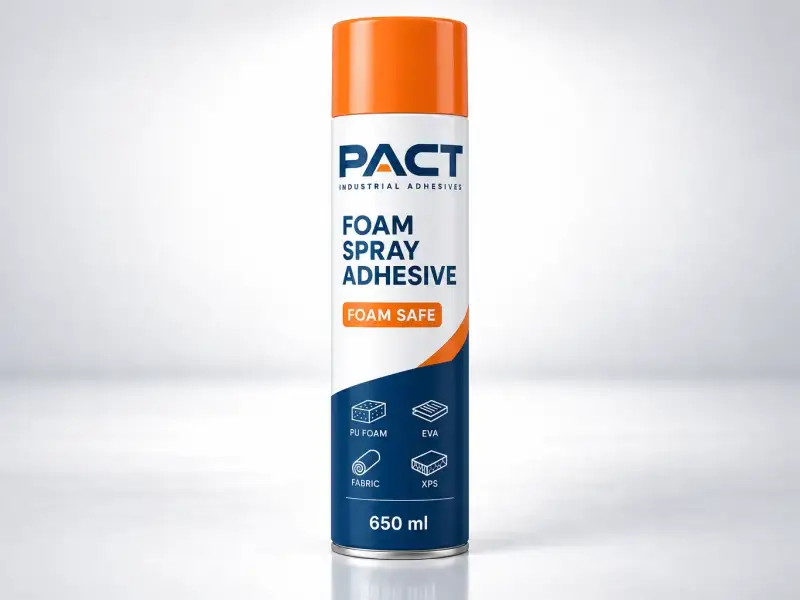
Foam spray adhesive is engineered with a solvent system that bonds effectively to foam substrates without causing chemical damage. This is a critical formulation challenge because expanded polystyrene (EPS) and extruded polystyrene (XPS) — two of the most common insulation foam materials — dissolve in aromatic solvents such as toluene and xylene, in ketones such as acetone and MEK, and in many esters. A foam-safe formulation is built around solvents with low solvency for polystyrene, typically aliphatic hydrocarbons, and that is a compromise: the solvents kindest to the board are not the strongest carriers for the adhesive polymer. The solvent system for this grade is listed on its SDS.
The primary application for foam spray adhesive is insulation board installation in construction and HVAC systems. When bonding XPS or EPS insulation panels to concrete walls, metal ductwork, or ceiling substrates, the adhesive must provide immediate grab strength to hold boards in place while developing permanent bond strength over 24-48 hours. Our formulation achieves this through a high-tack SBS/CR polymer blend that reaches bonding readiness in 30-90 seconds. The wide fan spray pattern ensures even coverage across the full panel surface, eliminating cold spots where delamination could occur under thermal cycling.
Beyond insulation, foam spray adhesive serves packaging fabrication, mattress manufacturing, and acoustic panel installation. In custom packaging production, the adhesive bonds polyethylene (PE) foam, EVA foam, and polyurethane foam pieces into protective inserts for electronics, medical equipment, and fragile goods. For acoustic treatment, the adhesive secures sound-absorbing foam panels to walls and ceilings in recording studios, theaters, and industrial noise reduction applications. The temperature resistance range of -20 to +80 degrees Celsius ensures bond integrity across seasonal temperature variations in both interior and exterior applications.
Which Foams, and What to Check First
"Foam" covers materials that fail in completely different ways. Polystyrene boards are at risk from the solvent; polyethylene foams are at risk from not bonding at all; flexible PU foam is rarely damaged but can end up with a hard glue line. Match the check to the foam:
| Foam | Main risk | Check before production |
|---|---|---|
| Flexible PU (conventional, HR, memory) | Solvent attack is rare; the problems are soak-in on open cells and a glue line that feels hard | Coat weight, feel of the finished cushion, and bond after the foam is compressed and released |
| EPS (expanded polystyrene) | Solvent attack — the surface softens, pits or collapses | Spray a test patch and inspect after the solvent has flashed off, not only at first contact |
| XPS (extruded polystyrene) | Same solvent sensitivity as EPS; a smooth extrusion skin can also reduce grab | Test on the actual board face; some boards need the skin roughened |
| EPE and PE foam | Not solvent attack but low surface energy — the adhesive dries on the surface and peels off cleanly | Peel a cured test piece by hand; PE often needs a PE-specific grade, surface treatment, or another joining method |
| EVA foam | Surface finish and additives vary between suppliers | Re-test when the EVA supplier changes, not only when the thickness does |
| Rebonded (chip) foam | High absorption into the open structure starves the glue line | Whether a light first coat, allowed to tack, then a second coat gives a continuous film |
This table lists what to check, not a compatibility guarantee. The test on your own foam grade decides — send us a sample of the foam and we will run it.
Permanent, temporary or removable? This is a permanent bonding grade. Where a part only has to hold until it is sewn or clamped, or has to peel off later without residue, ask for a repositionable grade rather than spraying less of a permanent one — a light coat of permanent adhesive still ends up permanent.
Key Features
- Formulated for PU foam, EVA and polystyrene boards (EPS/XPS); PE and EPE foams need a surface check first
- High initial grab — holds foam in place immediately without clamping
- Flexible bond — accommodates foam expansion and contraction
- Solvent blend chosen not to attack polystyrene — confirm on your board grade with a test patch
- Sprayable by aerosol can or bulk spray gun
- Temperature resistant from -20°C to +80°C
Technical Specifications
| Parameter | Value |
|---|---|
| Type | Aerosol / Bulk spray adhesive |
| Base Polymer | SBS / CR blend |
| Solid Content | 30-40% |
| Spray Pattern | Wide fan spray |
| Coverage | 3-5 m² per 550ml can |
| Tack Time | 30-90 seconds |
| Bond Strength (Peel) | ≥1.2 N/mm (foam-to-foam) |
| Heat Resistance | -20°C to +80°C |
| Can Sizes | 450ml, 550ml, 650ml aerosol |
| Propellant | CFC-free |
| Shelf Life | 24 months |
| Bulk Format | 20L drum for spray gun application |
Indicative values for the series. Figures move with the grade, the substrate pair, coat weight and cure conditions, so treat them as a basis for comparison rather than a specification — the technical data sheet for the grade you are supplied states the values that apply to it, and the conditions they were measured under.
Applications
- Insulation board installation — XPS and EPS foam to concrete/metal
- Packaging foam fabrication — custom protective packaging assembly
- Mattress manufacturing — foam layer lamination
- Acoustic panel installation — sound-absorbing foam bonding
- HVAC duct insulation — foam wrapping and sealing
Explore industry solutions: Mattress & Sofa, Construction.
Troubleshooting Foam Bonding
| Symptom | Likely cause | Check first |
|---|---|---|
| Foam melts, pits or shrinks under the glue | Solvent too strong for the foam — usually polystyrene | Confirm the grade is foam-safe for EPS/XPS; let the spray tack before closing the joint |
| Glue line feels hard through fabric or cushion | Coat too heavy, or full-cover spray where a web pattern would do | Switch to web spray and reduce coat weight; judge on the finished product, not a flat sample |
| Weak bond on open-cell or chip foam | The first coat soaked in | Apply a light first coat, let it tack, then a second |
| Bond lets go when the foam is compressed | Joined before tack developed, or only one surface coated on a high-stress edge | Wait for tack; coat both surfaces at edges and wrap-arounds |
| Clean peel from PE or EPE | Low surface energy, not a bad batch | Ask about a PE-specific grade or surface treatment |
| Stringing, cobwebs or spitting | Can or drum too cold, tip partly blocked, wrong spray distance, or adhesive thickened in a bulk line | Bring cans to room temperature, clean or replace the tip, flush bulk lines, and compare distance and pressure with the grade TDS |
To match a grade, send us the foam type and density, the second material, whether the bond is permanent or temporary, aerosol or bulk gun, your spray equipment, and any problem you have now. For foam-to-fabric work in sofas and mattresses, see upholstery spray adhesive.
Available Packaging
Foam spray adhesive is supplied in 450ml, 550ml, and 650ml aerosol cans with wide-fan spray nozzles optimized for large-area coverage, and in 20L drums for industrial spray gun application. Aerosol cans use CFC-free propellant systems. OEM and private label options include custom can design, branded labels, and specified nozzle configurations for target applications.
Certifications & Compliance
Quick Specs
- Type
- Aerosol / Bulk
- Bond Strength
- ≥1.2 N/mm (foam-to-foam)
- Tack Time
- 30-90 seconds
- Coverage
- 3-5 m² per 550ml can
- Temp Resistance
- -20°C to +80°C
Related Products
Get a Quote
Request pricing, samples, or technical data sheets for Foam Spray Adhesive.
Request a QuoteWater-based option
Could this job run water-based?
Foam bonding is where water-based gives up least. Open-cell foam draws part of the water out of the film, which is exactly what a pair of non-porous surfaces cannot do — so if you are going to test one application on your line, this is the one that starts with the odds in its favour.
- Foam-to-foam is not foam-to-board
- With board or coated fabric on one side the water has nowhere to go. A result from a foam-to-foam trial does not carry over to that joint; it needs its own.
- Grab, measured where your operators work
- Water leaves more slowly than solvent and slower still in humid air. Test initial grab at the point the part is actually handled, not only after full drying.
- Equipment and winter freight
- Spray equipment needs wetted parts and tips suited to a dispersion, and many dispersions are ruined by freezing — a risk a solvent product never had.
Frequently Asked Questions
Will spray adhesive dissolve or damage foam?
Can foam spray adhesive bond insulation board to concrete?
What is the difference between upholstery and foam spray adhesive?

Ready to Order Foam Spray Adhesive?
Contact our sales team for factory-direct pricing, bulk order discounts, and free product samples.