
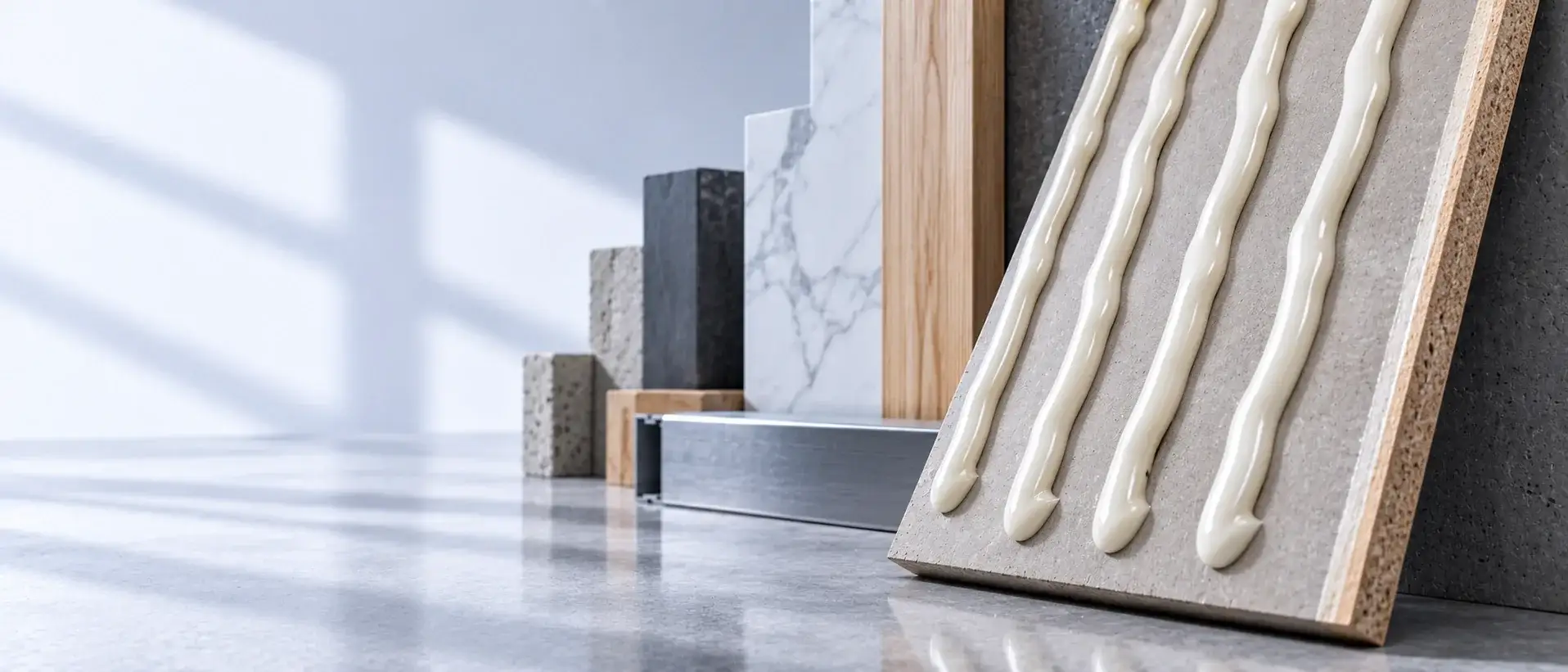
Construction Adhesive Manufacturer — Liquid Nails & Nail-Free Adhesive
Heavy-duty construction adhesives and nail-free bonding solutions for panels, tiles, baseboards, and building material installation. High grab strength with flexible cure.
Which grade for which job
Construction adhesive is not one product. The bead that holds a skirting board is the wrong material under a subfloor panel, and the one that works on drywall will not hold stone veneer on a façade. Find the job, then take the grade.
| Job | Bonding | Grade | Bond strength | Watch for |
|---|---|---|---|---|
| Subfloor | Plywood or OSB to timber joist | Heavy-duty | >2.5 MPa | Must stay flexible — the floor moves and squeaks if the bond goes brittle |
| Drywall & plasterboard | Board to stud, batten or masonry | Multi-purpose | 1.0–1.5 MPa | Paper face tears before the adhesive does — strength is not the constraint |
| Wall panelling | MDF, PVC or decorative panel to wall | Multi-purpose | 1.0–1.5 MPa | Solvent-borne grades can bleed through and mark thin PVC facings |
| FRP panel | Fibreglass-reinforced panel to board or block | Heavy-duty, solvent-free | >2.5 MPa | FRP is impermeable, so the bond cures only from the substrate side — allow longer |
| Trim, skirting, moulding | Timber or MDF profile to wall | Multi-purpose | 1.0–1.5 MPa | Initial grab matters more than final strength — it has to hold unclamped |
| Stone veneer & heavy panel | Stone, metal fixture or large panel to concrete | Heavy-duty | >2.5 MPa | Adhesive alone is rarely enough on a façade — check what the code requires |
| Mirror | Mirror to wall | Neutral, mirror-safe | 1.0–1.5 MPa | Solvent-borne adhesive attacks the silvered backing — ask for a mirror-safe grade |
| Wall tile | Ceramic tile to board | Usually the wrong product | — | See below — a cementitious tile adhesive is normally the right answer |
Initial grab develops in 5–15 minutes across all grades; full strength over 24–72 hours. Values are category-level references tested to ASTM D3498 and GB 18583 — request the technical data sheet for the grade you are specifying.
Liquid nails, nail-free, grab adhesive — the same product
Liquid Nails is a North American brand name that became the generic term for the category, the way Hoover did for vacuum cleaners. In the UK and Australia the same product is sold as grab adhesive orNo More Nails; specifications often call itnail-free adhesive, panel adhesive,construction adhesive or mounting adhesive. They all describe a high-grab, gap-filling adhesive applied from a cartridge to replace mechanical fixings. If your enquiry uses one of those names, this is the page you want — what actually differs between products is the chemistry and the grade, not the label.
Can you use construction adhesive for wall tile?
Usually not, and we would rather say so. Construction adhesive will hold a small ceramic tile on a dry interior wall, and it is genuinely useful for a repair or a single replacement tile. As a tiling system it is the wrong material for three reasons:
- —Wet areas. Construction adhesive is not formulated to sit permanently in water. A cementitious tile adhesive to EN 12004 / ANSI A118 is, and that is what a bathroom or a wet room needs.
- —Large format and floor tile. Adhesive applied in beads or dots leaves voids behind the tile. Under foot traffic or on anything above roughly 300 × 300 mm, those voids become cracks. Notched-trowel bed coverage is what prevents that.
- —Building codes and warranty. Most tiling specifications name a tile adhesive standard. A construction adhesive will not satisfy it, whatever the bond strength turns out to be.
Where construction adhesive does belong in a tiling job: fixing the backer board the tiles go onto, bonding trim and edge profiles, and repairs. If you need a tile adhesive proper, tell us — it is a different chemistry and a different quotation, and pretending otherwise would cost you a floor.
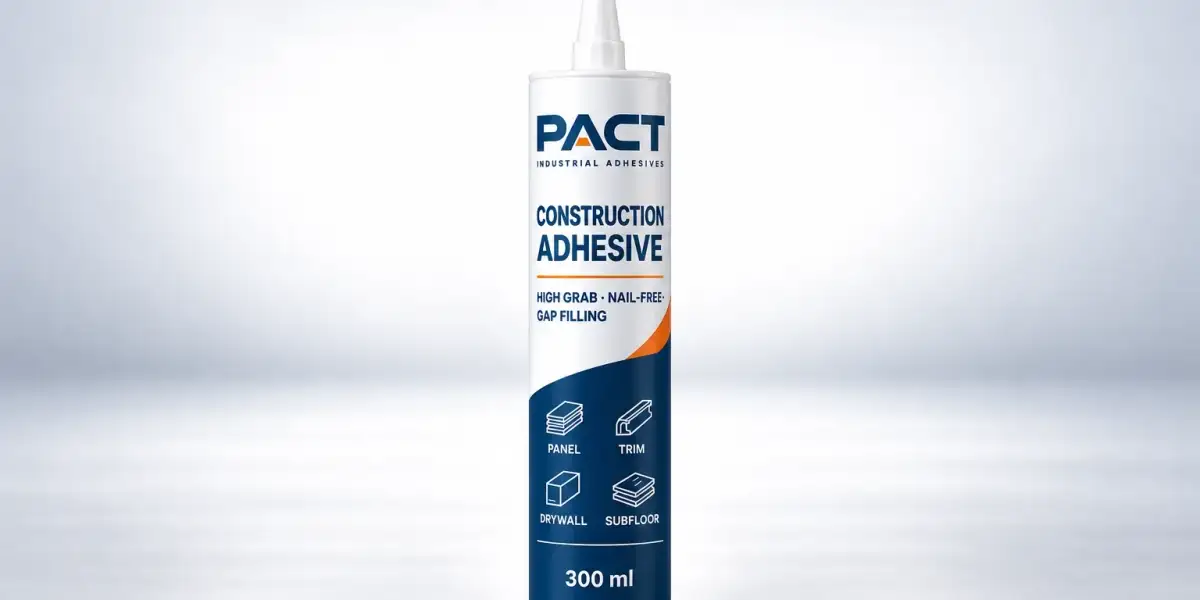
What Is Construction Adhesive?
Construction adhesive — also known as liquid nails, nail-free adhesive, or panel bonding adhesive — is a high-viscosity, high-grab bonding agent designed to bond building materials, alongside mechanical fixings or, where the installation system allows it, in place of them. It creates a continuous bond line that spreads load across the joint, can reduce the number of fastener holes, and gives a cleaner finish. Initial grab does not establish the load capacity of the installation: follow the approved fixing method and the adhesive grade's curing and support requirements.
Modern construction adhesive formulations are based on hybrid polymer technology (SMP — silyl modified polymer), polyurethane, or synthetic rubber in a solvent-free or low-solvent carrier. The adhesive is packaged in cartridges for caulking gun application and applies as a thick bead or series of dots on one substrate surface. Initial grab (holding power before full cure) develops within 5-15 minutes, allowing the installer to position materials and walk away without clamping or temporary fastening. Full structural bond strength develops over 24-72 hours as the adhesive cures through moisture reaction or solvent evaporation.
Formulations and Performance Grades
Heavy-Duty Construction Adhesive
Heavy-duty formulations are engineered for load-bearing applications: mounting stone veneer panels, bonding heavy decorative elements, attaching metal fixtures to concrete, and bonding large-format wall panels. These adhesives achieve ultimate bond strength exceeding 2.5 MPa on concrete-to-concrete substrates and provide high initial grab strength that holds heavy materials in position immediately after application. Heavy-duty construction adhesive uses hybrid polymer or polyurethane chemistry for maximum strength and weather resistance, making it suitable for both interior and exterior applications.
Multi-Purpose Nail-Free Adhesive
Multi-purpose nail-free adhesive is the general-purpose formulation for lighter construction and interior finishing tasks. It bonds baseboards and skirting boards, crown molding and trim, decorative panels, mirror mounting, signage installation, and light fixture attachment. Bond strength of 1.0-1.5 MPa is sufficient for these non-structural applications. Multi-purpose formulations are typically acrylic or synthetic rubber based, offering low odor, paintability, and easy cleanup with water before curing — practical advantages for interior finishing work in occupied buildings.
Where it substitutes for tile adhesive — and where it does not
There is a narrow case where construction adhesive genuinely beats cement-based tile adhesive: thin, light wall tiles and decorative tile panels applied to a dry interior surface, typically as a retrofit over an existing finish. Immediate grab means no spacers and no propping while it sets, and the flexible bond line tolerates substrate movement that would crack a rigid mortar bed.
That case is narrower than it sounds, and it is worth being precise about the boundary rather than selling past it. Wet areas, floors, anything above roughly 300 × 300 mm, and any job whose specification names EN 12004 or ANSI A118 all need a proper tile adhesive — the reasons are set out inthe section above. If you are unsure which side of that line your job falls on, send us the tile size, the substrate and whether the area gets wet.
Flooring, carpet tiles and wallpaper are installed with different adhesives again — mostly water-based acrylic, starch or cellulose — and depend on substrate moisture and absorbency more than on grab. See water-based flooring and installation adhesives.
Substrate Compatibility
A key advantage of construction adhesive over mechanical fasteners is its ability to bond a wide variety of building materials in any combination:
- —Porous substrates: Wood, plywood, MDF, OSB, particleboard, gypsum board (drywall), concrete, brick, and natural stone. Construction adhesive penetrates the pore structure to create mechanical interlocking bonds.
- —Non-porous substrates: Ceramic tiles, metal (steel, aluminum), PVC, acrylic, and glass. Hybrid polymer and PU formulations adhere well to non-porous surfaces without primer in most cases.
- —Dissimilar material bonding: One of the greatest strengths of construction adhesive is bonding different materials together — wood to concrete, metal to gypsum, PVC trim to masonry — applications where mechanical fasteners would be impractical or cause substrate damage.
Initial grab is not final strength
Grab is what holds a part in place in the first minutes; final strength arrives only as the adhesive dries or cures over the following days. A panel that stays put when you let go can still slide, creep or fall before the bond has developed — especially if it is heavy, overhead, or the room is cold.
- —Support heavy or tall items with props, battens or temporary fixings until the handling time on the TDS has passed.
- —Never rely on adhesive alone overhead. Ceilings and soffits need mechanical fixing, whatever the grab.
- —Allow longer in the cold. Both drying and moisture cure slow down at low temperature, so the handling time on the TDS stretches too.
When both surfaces are non-porous
How an adhesive loses its carrier or cures decides whether it can work between two surfaces that absorb nothing — PVC to tile, metal to glazed board:
| Chemistry | How it sets | Between two non-porous surfaces |
|---|---|---|
| Water-based acrylic | Water must escape into a surface or the air | Poorly — at least one surface should be absorbent |
| Solvent-borne rubber | Solvent evaporates | Only if applied, left to flash off, then joined; can attack polystyrene and mark thin PVC |
| Hybrid polymer (MS / SMP) | Cures with moisture from the air | Works, but thick beads cure slowly with no moisture path |
| Polyurethane | Cures with moisture | Works; similar slow cure in wide, enclosed beads |
Ask which chemistry the grade you are quoted uses; it decides more than the bond-strength figure does.
Beads, dabs or full spread
- —Vertical beads on walls let air reach the adhesive and let any water run out; horizontal beads trap both.
- —Zig-zag or S-beads spread load on panels without sealing the back into a closed pocket.
- —Dabs bridge uneven walls and suit mirrors, which should never be fully coated — air needs to circulate behind the glass.
- —Keep beads back from edges so pressing the part does not squeeze adhesive out onto the face.
- —Full trowel spread is a flooring and tiling method, not a construction-adhesive one — see flooring adhesives and tile.
Interior, humid, exterior, wet: where the limits are
| Condition | What changes | What to specify |
|---|---|---|
| Dry interior | Little beyond the substrate and the load | Multi-purpose grade matched to the job table above |
| Humid interior (kitchens, bathrooms) | Moisture reaches the bond line; water-based grades may soften | A grade rated for humid interiors; hybrid polymer usually |
| Exterior, sheltered | Temperature cycling and UV at exposed edges | An exterior-rated grade; protect or cover exposed bead |
| Exterior, exposed and façades | Weather, thermal movement, and codes that may require mechanical fixing | The system the façade specification names — adhesive alone is rarely accepted |
| Wet or submerged | Permanent water breaks down most construction adhesives | A product rated for immersion, or a different system |
| Overhead | Gravity acts on the bond before it cures | Mechanical fixing in all cases |
Comparing cost per metre, not per cartridge
Cartridge price says little about what a job costs. What matters is how many metres of bead a pack delivers at the bead size the job needs, how much is wasted, and how long it takes to apply. As an illustration of the arithmetic only: a round 6 mm bead has a cross-section of about 28 mm², so a 300 ml cartridge lays roughly 10 m of it; at a 10 mm bead the same cartridge lays under 4 m. A 600 ml sausage gives twice the length with less packaging waste left in the gun.
Compare candidates at the bead size and pattern the job actually uses, add nozzle and part-used cartridge waste, and cost it per metre or per panel installed. Packaging formats covers the pack sizes by market.
Packaging formats and colours
Pack format is not a detail — it decides whether the product runs on your customers' guns and how many units fit in a container. North America works in ounces and gallons, most other markets in millilitres and kilograms, and the two do not map onto each other neatly.
| Format | Metric | US equivalent | Applied with |
|---|---|---|---|
| Cartridge | 300 ml | ≈ 10.1 fl oz | Standard caulking gun |
| Cartridge | 400 ml | ≈ 13.5 fl oz | Standard caulking gun |
| Sausage / foil pack | 600 ml | ≈ 20.3 fl oz | Sausage gun — less waste, cheaper to ship |
| Pail | 20 kg | Bulk | Trowel or bulk dispensing equipment |
Buying for North America? The formats that sell there — 10 oz and 29 oz cartridges, and 1 or 5 US gallon pails — are not our standard European and Asian sizes. Tell us the pack format your market expects and we will quote against that rather than asking you to re-sell ours; cartridge tooling and fill volumes are part of what an OEM run sets up. See OEM and ODMfor how that works.
Colour
Construction adhesive is normally specified in a colour that disappears into the job rather than one that stands out. White and off-white suit interior trim and drywall work;beige and almond are chosen to match sanitary ware and timber; grey reads as concrete on structural and exterior work; black is used where the bond line is visible against dark cladding or in marine and vehicle interiors. Tell us which the job needs when you send a specification — colour is set during the batch and is straightforward on an OEM run, but it is not something to change after the cartridges are filled.
Performance in Tropical Climates
Many of PACT's export markets are in tropical and subtropical regions where construction adhesive must perform under challenging conditions: ambient temperatures consistently above 30°C, relative humidity exceeding 80%, monsoon rain exposure during construction, and UV radiation that degrades inferior adhesive formulations. Our construction adhesive formulations are specifically tested and adjusted for these conditions.
High-humidity environments accelerate moisture-cure reactions, which can shorten working time but improve cure speed. Our formulations balance these effects to maintain adequate working time (10-15 minutes for positioning) while achieving rapid initial grab development. For exterior applications, our heavy-duty formulation maintains bond integrity through wet-dry cycling, UV exposure, and temperature fluctuations from 0°C to 50°C. Accelerated weathering tests simulate 10+ years of tropical exposure to validate long-term performance before product release.
VOC Limits for Construction Adhesive Are Set by the Job
Under California's SCAQMD Rule 1168 a construction adhesive is limited by what its label says it is for: 70 g/L as a multi-purpose construction adhesive, 50 g/L as a subfloor adhesive and 50 g/L as a dry wall and panel adhesive. All three are counted less water and exempt compounds, and a product that claims several uses has to meet the lowest of their limits. A cartridge sold for both general construction and subfloor work is therefore a 50 g/L product, not a 70 g/L one.
Carrier decides how hard that is to meet. Solvent-free hybrid polymer grades and water-based acrylics start close to these figures; a solvent-borne rubber grade is the one to check before quoting it into a regulated project. Ask for the VOC figure for the exact grade against the category on your label, and see VOC limits by market for the full table. Flooring and installation work has its own water-based adhesives, and the other product lines are in low VOC adhesives by product line.
Why Source Construction Adhesive from PACT
- —Tropical-optimized formulations: Unlike European or North American products designed for temperate climates, our construction adhesive is developed and tested for hot, humid conditions common across our export markets.
- —Competitive export pricing: Factory-direct manufacturing in Guangzhou with no intermediary markups. Cartridge filling, labeling, and packaging all handled in-house for cost efficiency.
- —Private label ready: Full OEM service including custom cartridge design, label printing in any language, branded carton packaging, and technical documentation. Private label orders follow the standard MOQ of the selected product.
- —Quality testing: Every batch tested for initial grab strength, ultimate bond strength on multiple substrates, heat resistance, and accelerated aging. Full test reports and MSDS documentation provided with shipment.
Frequently Asked Questions
What is the VOC limit for construction adhesive?
Can construction adhesive be used for subfloor installation?
Which grade should I use on drywall and plasterboard?
Can I use construction adhesive instead of tile adhesive?
Do you supply construction adhesive in gallon pails or US cartridge sizes?
What substrates can your construction adhesive bond?
What is the difference between your heavy-duty and multi-purpose formulations?
How is your construction adhesive packaged?
Can you supply construction adhesive for tropical climates?
Construction adhesive — selection, compliance and supply
- Water-based flooring and installation adhesives
Resilient flooring, carpet tiles, light mounting and substrate moisture.
- Bonding laminate and panel to board
Where a construction adhesive stops being the right answer and a contact adhesive starts.
- Seal the joint after you have bonded the panel
Neutral and acetoxy sealants for the perimeter work that follows.
- Fill gaps around the opening with PU foam
Yield against post-expansion, and why a B1 class is not a fire-resistance rating.
- What building-materials buyers specify
Panel mounting, glazing, insulation and the loads each has to carry.
- Bonds that have to survive heat
Where standard construction adhesive gives up and what replaces it.
- Check the VOC limit for your destination market
Which instrument actually governs adhesives in the US, EU and China — and which ones are wrongly cited.
- Review our certifications and test reports
ISO 9001, ISO 14001, REACH statements and SGS reports, and what each one covers.
- Put your own brand on it — OEM and ODM
Custom labels, cartons and formulation adjustments from our existing lines.
- Eight checks before you pick a supplier
Manufacturer or trader, grade-level test data, VOC position and dangerous-goods handling — apply them to us too.
- Look up a term and its other names
Non-acid silicone is neutral cure; liquid nails is grab adhesive. Fifty terms with their synonyms.
- Send a specification and get a quote
Substrate, volume and destination market are enough for us to price it.
Need a Custom Construction Adhesive Formulation?
Whether you need a heavy-duty panel adhesive, multi-purpose nail-free glue, or a product tailored to tropical climate performance, our technical team is ready to develop the right solution.