
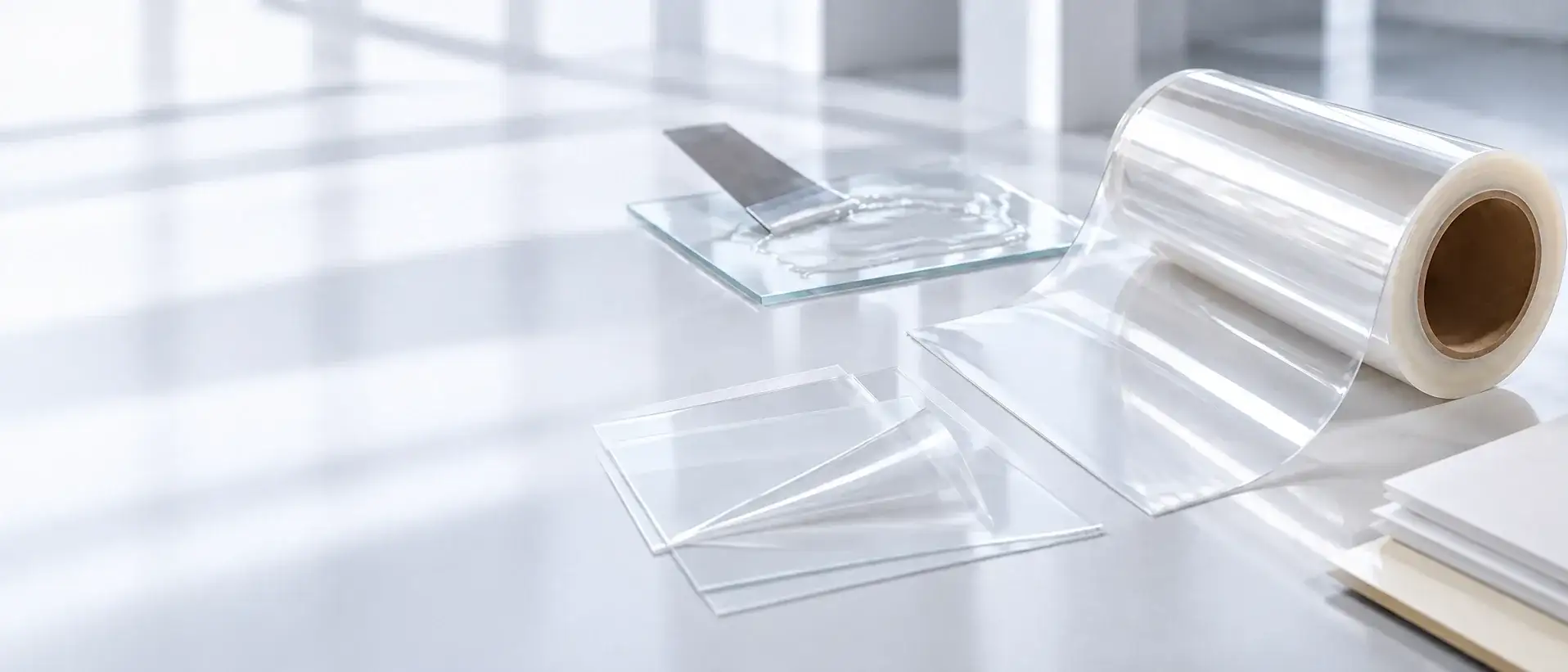
Water-Based Acrylic Protective Film Adhesives
Surface protection film is judged at removal, not on application: it must not lift while the part is cut, drawn or handled, and it must come away cleanly after the real dwell time. Both depend on the surface, the film backing and what the part goes through in between.
An application we assess on request. Share your substrates, process and target requirements and we will confirm suitability, available documentation and sourcing feasibility — no stock grade is listed yet.
Discuss Your Application
Two Opposite Failures
Protective film fails in two directions, and a fix for one causes the other. It lifts — during laser cutting, deep drawing, bending or transport — leaving the surface exposed or contaminated at the edges. Or it will not come off cleanly, leaving residue, marking a coating or tearing as it is pulled. Between those sits a window that has to hold across your whole process, not just on day one.
That window moves. Peel force climbs with dwell time, heat and UV, so the same film can be right at a week and wrong at six months outdoors. A specification that names only tack cannot capture this; one that names the fabrication steps, the dwell time and the exposure can.
The Surface Decides More Than the Metal
| Surface | What to watch |
|---|---|
| Brushed stainless steel | The grain holds the adhesive mechanically, so peel force climbs faster than on a polished panel |
| Mirror-polished stainless steel | Low peel at first, and any lifting during handling shows immediately |
| Powder-coated or painted aluminium | The coating, not the metal, decides removability — and coatings vary between batches and suppliers |
| Anodised and mill-finish aluminium | Surface treatment and residual rolling oil both change wetting |
| PMMA and polycarbonate sheet | Solvent sensitivity and stress cracking; masking is often applied by the sheet producer |
| Glass and coated glass | Coatings can be softer than the glass; removal must not mark them |
| Profiles and textured surfaces | The film has to conform, or air channels leave unprotected areas |
Where the part is painted, powder-coated or anodised, that layer is the bonding surface — qualify against it rather than against "aluminium", and re-test when the coating supplier or batch changes.
A Test That Settles It
- Apply the film to the actual surface and finish, on your laminator, at production speed and pressure.
- Put masked parts through the real fabrication steps — cutting, drawing, bending, handling — and record any lifting at edges and corners.
- Age samples for the longest realistic dwell time, including outdoor storage, heat and sunlight if parts see them.
- Remove at the speed and angle used in production, manual or machine.
- Inspect against your own criteria: adhesive residue, staining, marked coating, ghosting on gloss surfaces.
- Repeat when the surface supplier, the coating or the fabrication route changes — each of those moves the window.
What to Tell Us
| Parameter | Why it matters | What to tell us |
|---|---|---|
| Surface and finish | Peel build-up differs between brushed, polished and coated surfaces even on the same metal. | Exact material and finish, and the coating supplier if painted |
| Film backing and its treatment | The adhesive has to anchor to the backing as firmly as it releases from the surface. | PE or PET, thickness, corona treatment |
| How the film is applied | Lamination pressure, speed and temperature set the starting contact area. | Laminator type, speed, roller pressure |
| Fabrication after masking | Laser cutting, deep drawing, bending and punching each stress the bond differently. | Which processes the masked part goes through |
| Dwell time | Peel force climbs with time; a film that peels cleanly after a day may not after months. | Longest realistic time before removal |
| Exposure | Heat and UV accelerate peel build-up and can bake residue onto the surface. | Indoor or outdoor storage, temperature, sunlight |
| Removal | Peel force depends on angle and speed, and hand removal differs from machine removal. | Manual or automated, and the speed |
| What counts as failure | Residue, staining, lifted edges and marked coatings are different defects with different causes. | Your inspection criteria |
Coating parameters and the tack, peel and shear methods behind any figure are on the acrylic adhesives page. For labels that stay on the pack, see label stock adhesives.
Frequently Asked Questions
Is "low tack" a specification?
Why did the film peel cleanly in testing and leave residue in production?
The same film works on one aluminium part and not another. Why?
Does the film backing matter as much as the adhesive?
Do you supply protective film adhesive?
Sources
- Dow, Acrylic pressure-sensitive adhesives
- BASF, High-performance sustainable adhesive technologies for specialty tapes
These references describe the technology in general. Performance figures from other manufacturers apply to their products, not to PACT grades, and a citation does not imply endorsement. Content reviewed September 16, 2026.
Before you approve a protective film
- Label adhesives, where the bond has to last
The opposite requirement, specified from the same three temperatures.
- Coating and drying parameters
Coat weight, solids and drying — what a quotation assumes about your line.
- Protective film in the selection guide
What to confirm, what rules a candidate out, and what to test.
- Why a number without its method is not comparable
Applies to peel build-up figures as much as to bond strength.
- Storage before the film reaches your line
Heat and frost change a dispersion before it is ever coated.
- All water-based options by application
Which applications have a listed grade and which we assess on request.
- Check the VOC limit for your destination market
Which instrument actually governs adhesives in the US, EU and China — and which ones are wrongly cited.
- Send a specification and get a quote
Substrate, volume and destination market are enough for us to price it.
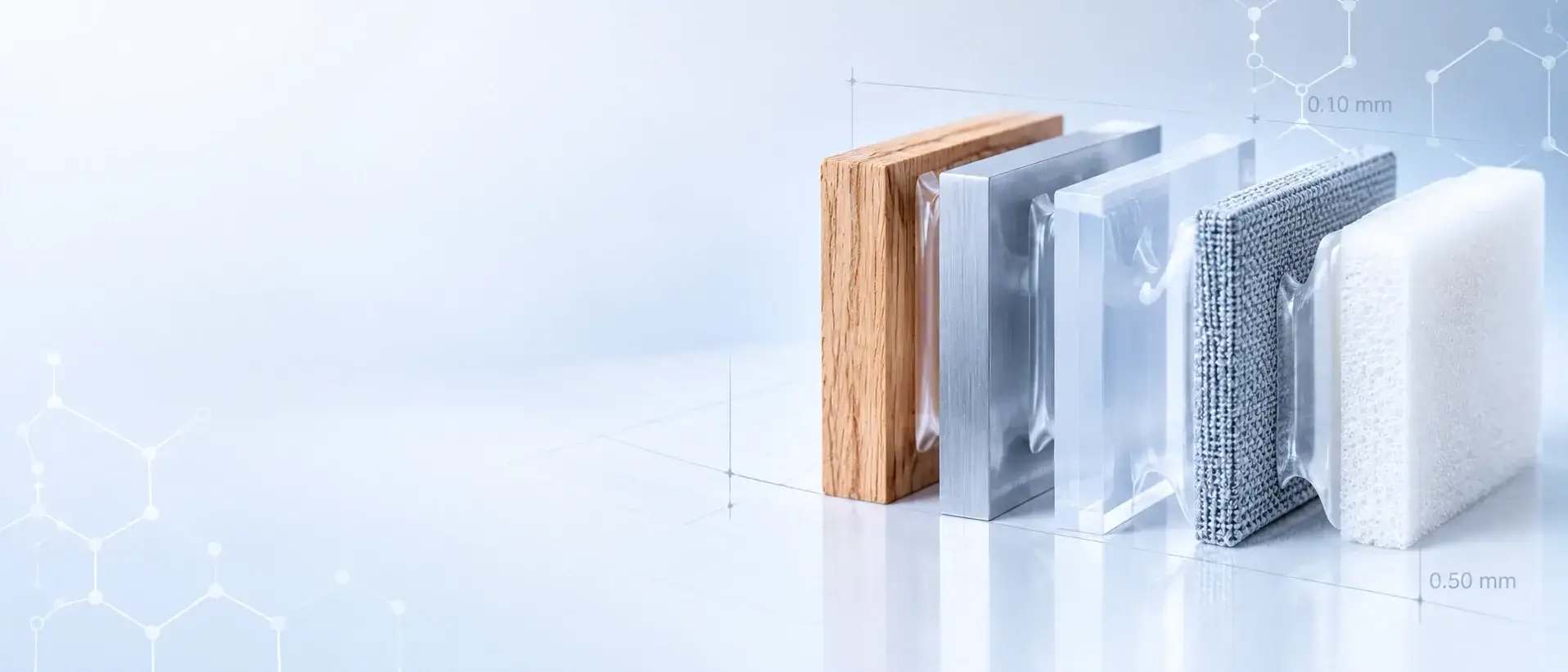
Share Your Materials and Process
Share the materials you need to bond or coat, your application process and any target specification. We will review the request and confirm sourcing feasibility, available documentation and next steps.