
Technical reference
Adhesive Storage and Shelf Life
How long each chemistry keeps, what heat and frost actually do to it, how to tell a drum has gone — and why a container crossing the tropics is the hardest storage condition your adhesive will ever see.
Last updated: 2026-09-07
The short version
Most of our adhesives keep 12 months sealed, between 5°C and 35°C, out of sunlight. Water-based grades must never freeze (what else changes with water-based adhesive). Aerosols and PU foam must stay below 50°C and stand upright. Silicone cartridges want a tighter window, 5–27°C.
The figure that matters more than any of those is the one nobody publishes: the inside of a shipping container crossing the tropics runs at 60–70°C, which is outside every window above. If your product arrives thick, skinned or short-lived, that voyage is usually where it happened.
Shelf life by product
Sealed, in original packaging, from the date of manufacture — which is printed on every package alongside the expiry date. Ask for the production date when you receive a shipment; a batch that spent three months in transit and a warehouse has already used a quarter of its life.
| Product | Shelf life, sealed |
|---|---|
| Neoprene Contact Adhesive | 12 months (sealed, 5-35°C) |
| SBS Contact Adhesive | 12 months (sealed, 5-35°C) |
| Water-Based Contact Adhesive | 6-12 months (sealed, 5-35°C, avoid freezing) |
| PU Shoe Adhesive | 9-12 months (sealed, 5-30°C) |
| Neoprene Shoe Adhesive | 12 months (sealed, 5-35°C) |
| Upholstery Spray Adhesive | 24 months |
| Foam Spray Adhesive | 24 months |
| Neutral Silicone Sealant | 12 months (sealed, 5-27°C) |
Aerosol products should be stored upright. Expiry is not a cliff — a product a month past date is usually still serviceable and a product stored badly can fail well inside date. Test, do not assume in either direction.
What actually goes wrong, and whether it is recoverable
| Condition | Affects | What happens | Verdict |
|---|---|---|---|
| Frozen | Water-based adhesive | Irreversible. The emulsion breaks and the polymer separates out as grains that will not redisperse. It may look normal once warmed. | Scrap it |
| Frozen | Solvent-borne adhesive | Usually recoverable. Viscosity rises sharply but the polymer stays in solution. Warm slowly to room temperature and stir before judging it. | Warm and test |
| Sustained heat above 40°C | All liquid adhesive | Shelf life shortens roughly by half for every 10°C above the storage window. Solvent-borne grades also build internal pressure in sealed tins. | Test before use |
| Sustained heat above 50°C | Silicone sealant cartridges | Premature partial cure. The cartridge may still extrude but skins faster and loses movement capability. | Test before use |
| Sustained heat above 50°C | Aerosols and PU foam cans | Internal pressure rises. Above roughly 50°C this becomes a safety issue, not just a quality one. | Do not store — safety |
| Container left open | Solvent-borne adhesive | Solvent evaporates and viscosity climbs. Skinning starts at the surface within hours. | Reseal, then thin |
| Container left open | Silicone and PU | Moisture-cured chemistries begin curing on contact with air. A skinned cartridge nozzle is normal; a cured cartridge body is not recoverable. | Trim nozzle or scrap |
The frozen water-based case is the dangerous one, because the material looks normal again once it warms. If a water-based shipment has been through a frost, quarantine it and test before it reaches a line.
The container is the hardest storage condition
Every storage window on this page assumes a warehouse. A steel box on the deck of a ship in the tropics is not a warehouse. Internal temperatures of 60–70°C are ordinary in direct sun, and on our main routes the cargo holds them for a substantial part of the voyage:
| Route | Typical transit | Heat exposure |
|---|---|---|
| Southeast Asia | 18-22 days | Continuous tropical; short but no cool period |
| Middle East | 25-30 days | Severe in summer; Gulf discharge ports add days on the quay |
| Africa | 30-45 days | Long, hot, and often followed by unconditioned storage |
| Latin America | 35-55 days | Longest leg; equator crossing in both directions on some routings |
What to do about it
- —Ask for the production date, not just the expiry. It tells you how much life the batch had before the voyage started.
- —Request stowage below deck. A container on the top tier in the sun runs far hotter than one in the hold. It is a request your forwarder can make.
- —Do not consolidate adhesive with heat-generating or heat-sensitive cargo. With dangerous goods this is often a rule rather than a preference — see shipping and documentation.
- —Ship aerosols and PU foam in the cooler months where the schedule allows. Above roughly 50°C these become a safety question, not a quality one.
- —Treat arrival as the start of usable life. Run a viscosity and peel check on the first drum of a container before it goes to a line, and keep a retained sample.
If your market runs hot year-round, say so at the enquiry stage. Formulation, packaging and stabiliser package can all be adjusted for it, and that conversation is much cheaper before production than after a container arrives thick.
Warehouse practice
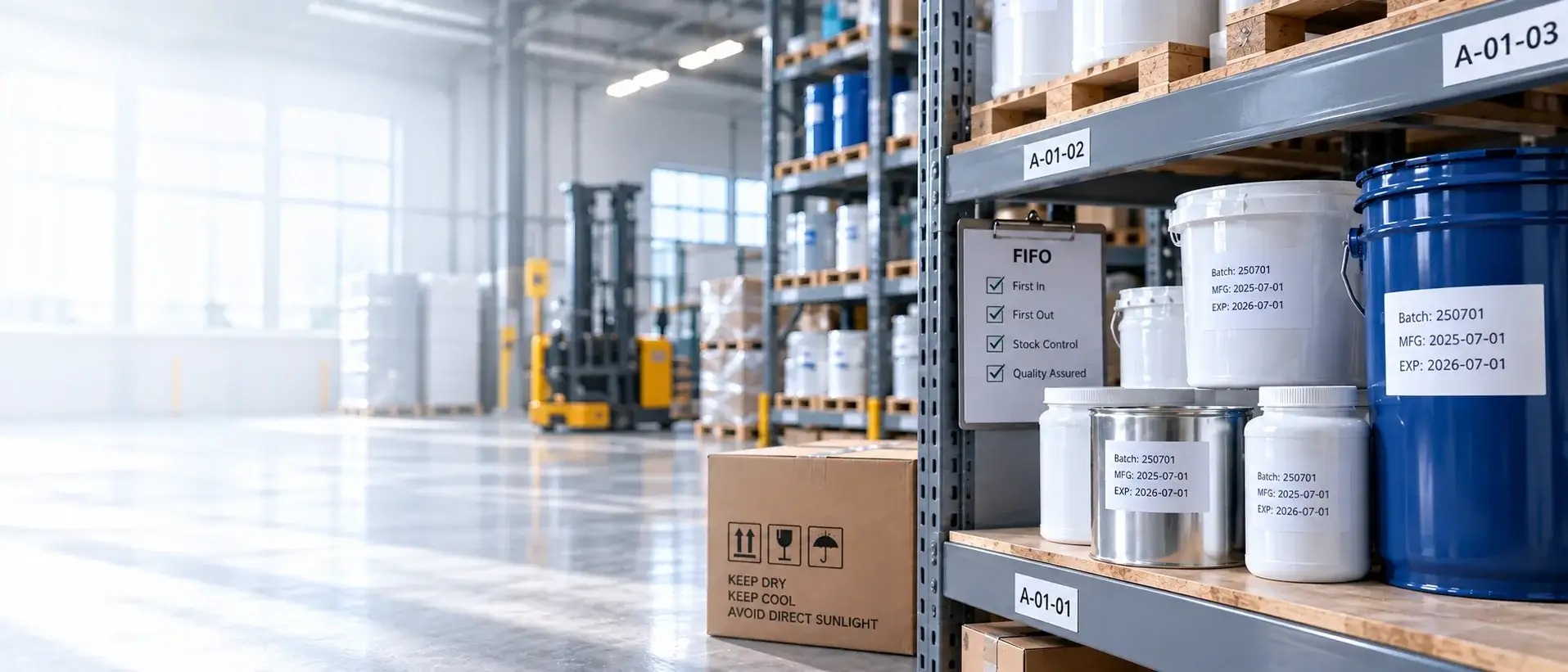
- —First in, first out, by production date. Not by delivery date — a later delivery can easily hold an older batch.
- —Off the floor, away from the wall, out of the sun. A pallet against a west-facing steel wall sees most of the container problem again, in miniature, every afternoon.
- —Solvent-borne product needs ventilated, fire-rated storage separated from ignition sources. It is a Class 3 flammable liquid in the warehouse as well as on the ship.
- —Aerosols upright, always. Stored on their side the valve sits in liquid rather than propellant and can leak or block.
- —Decant what a shift will use. Opening a 200 kg drum daily costs more solvent — and more shelf life — than most plants realise.
Frequently asked questions
Can adhesive be used after it has frozen?
How long does adhesive last once the container is opened?
Can thickened adhesive be thinned back with solvent?
How do I tell whether adhesive has gone off?
What temperature does a shipping container reach, and does it affect the adhesive?
How should expired or unusable adhesive be disposed of?

Shipping somewhere hot?
Tell us the destination and the season at the enquiry stage. Formulation, packaging and stabiliser package can be adjusted for a hot route — which is far cheaper than diagnosing it after the container lands.