
Neoprene Shoe Adhesive
Chloroprene rubber (CR) based shoe adhesive for footwear assembly, upper bonding, and insole lamination. Provides strong immediate tack and reliable bond performance for high-volume production.
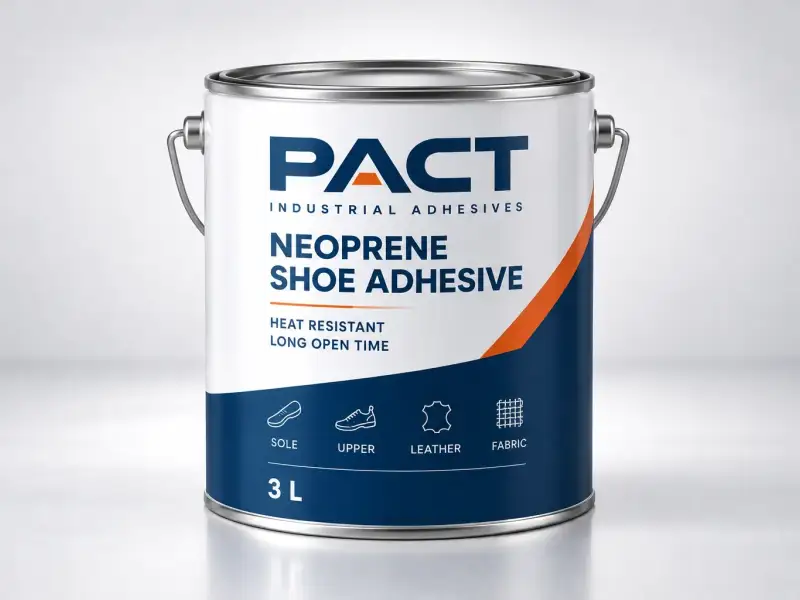
Neoprene shoe adhesive is a chloroprene rubber (CR) based formulation specifically optimized for the demands of footwear production lines. While sharing the same base polymer as general-purpose neoprene contact adhesive, the shoe-grade version is engineered with modified resin systems and tackifier blends that prioritize two critical production attributes: high initial tack and fast drying time. In a footwear factory producing thousands of pairs per day, the speed at which an adhesive reaches bonding-ready state directly impacts throughput and labor efficiency.
The formulation achieves an open time of 8-15 minutes at standard conditions, which is shorter than general neoprene contact adhesive. This faster tack development allows shoe production workers to apply adhesive, wait a brief period, and bond components without extended idle time. The initial tack is aggressive — components bond immediately upon contact pressure, holding parts in position for subsequent operations. This is particularly important in upper assembly and lasting, where pieces must stay aligned while the shoe moves through production stations including roughing, cementing, pressing, and cooling.
Our neoprene shoe adhesive delivers heat resistance up to 90 degrees Celsius, which exceeds the thermal demands of most footwear assembly processes. The adhesive maintains reliable performance on footwear-specific substrates including natural leather, synthetic leather (PU and PVC), woven and non-woven textiles, EVA foam, natural rubber, and TPR. For factories using neoprene shoe adhesive alongside PU adhesive in a dual-adhesive process — neoprene for pre-bonding and upper work, PU for final sole attachment — our formulations are designed to be fully compatible, ensuring no adhesion conflicts between layers.
Key Features
- High initial tack — bonds immediately on contact for fast production
- Heat resistance up to 90°C with a bond line that stays flexible through repeated bending
- Optimized for footwear substrates: leather, synthetic leather, fabric, rubber
- Brush and spray application for different bonding operations
- Fast drying — 8-15 minute open time at standard conditions
- Strong peel strength ≥2.5 N/mm on leather-to-rubber
Technical Specifications
| Parameter | Value |
|---|---|
| Base Polymer | Chloroprene Rubber (CR / Neoprene) |
| Solid Content | 20-25% |
| Viscosity | 2,500-4,000 mPa·s |
| Density | 0.85-0.90 g/cm³ |
| Open Time | 8-15 minutes |
| Bond Strength (Peel) | ≥2.5 N/mm (leather-to-rubber) |
| Heat Resistance | -20°C to +90°C |
| Color | Yellow / Amber |
| Flash Point | ≤-4°C |
| Shelf Life | 12 months (sealed, 5-35°C) |
| Packaging | 0.5L, 1L, 3L, 15L tin cans; 200L drums |
Indicative values for the series. Figures move with the grade, the substrate pair, coat weight and cure conditions, so treat them as a basis for comparison rather than a specification — the technical data sheet for the grade you are supplied states the values that apply to it, and the conditions they were measured under.
Applications
- Upper-to-sole pre-bonding before PU adhesive application
- Insole and midsole lamination
- Heel and counter attachment
- Leather upper assembly and lasting
- General footwear workshop repairs
See our industry solutions: Footwear & Leather, Leather Goods.
Available Packaging
Neoprene shoe adhesive is available in 0.5L, 1L, 3L, and 15L tin cans suited for production line stations, plus 200L drums for high-volume factory supply. Smaller cans are commonly used at individual workstations, while drums are positioned at central dispensing points. Custom packaging and private label services are available for distributor and OEM orders.
Certifications & Compliance
Quick Specs
- Base Polymer
- CR (Neoprene)
- Bond Strength
- ≥2.5 N/mm (leather-to-rubber)
- Heat Resistance
- -20°C to +90°C
- Open Time
- 8-15 minutes
- Solid Content
- 20-25%
Related Products
Get a Quote
Request pricing, samples, or technical data sheets for Neoprene Shoe Adhesive.
Request a QuoteWater-based option
If a brand is asking for water-based
In footwear the switch usually is not the factory’s decision — it arrives through a customer’s restricted substance programme. The thing worth knowing before you start: changing the adhesive alone does not satisfy one.
- Declarations are per product, not per chemistry
- Brand RSLs and the ZDHC MRSL apply to the adhesive, hardener, primer and cleaner separately. Ask for documentation naming each product rather than a statement about the adhesive type.
- The primer often stays solvent-borne
- Sole preparation may still use a solvent primer or halogenation, so the line does not become solvent-free because the adhesive changed.
- Activation, flex and hydrolysis
- Water-based PU systems dry and heat-reactivate on a different schedule. Bond strength, flex life and hydrolysis resistance all need re-testing on your own sole materials.
Frequently Asked Questions
When should I use neoprene vs PU shoe adhesive?
Can neoprene shoe adhesive be used as the primary sole bonding adhesive?
How does your neoprene shoe adhesive differ from standard neoprene contact adhesive?
Ready to Order Neoprene Shoe Adhesive?
Contact our sales team for factory-direct pricing, bulk order discounts, and free product samples.