
PU Shoe Adhesive
High-performance polyurethane (PU) adhesive specifically formulated for footwear manufacturing. Delivers superior flex resistance, heat resistance, and bond durability for sole-to-upper bonding.
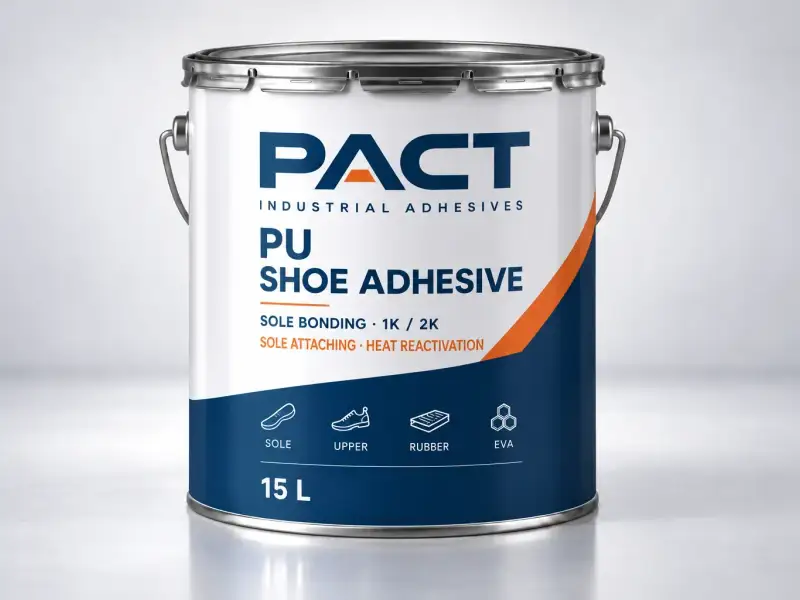
Polyurethane (PU) shoe adhesive is the gold standard for permanent sole bonding in modern footwear manufacturing. The adhesive is based on hydroxyl-terminated polyester or polyether polyurethane prepolymers that, when combined with a crosslinker (isocyanate hardener in two-component systems) or exposed to atmospheric moisture (one-component systems), form a dense, cross-linked polymer network. This chemical cross-linking is what gives PU shoe adhesive its defining characteristics: exceptional peel strength, outstanding flex fatigue resistance, and durable performance under repeated mechanical stress.
The heat reactivation process is central to PU shoe adhesive application on production lines. After both mating surfaces are coated with adhesive and allowed to dry, the adhesive film is reactivated by passing the components through an infrared or hot-air oven at 65-75 degrees Celsius. This reactivation step melts the crystalline structure of the PU film, restoring its tackiness and allowing the sole and upper to be pressed together under pressure. Once the bond has cured, compare bond-strength results obtained under the same method and conditioning — EN 1392, for example, specifies how the bond strength of footwear adhesive joints is tested — and ask for the report for the proposed grade, substrate pair and surface preparation. Flexing durability requires its own defined test and result, usually set by the brand's protocol.
Our PU shoe adhesive is offered in both one-component and two-component configurations. One-component PU adhesive provides simplicity and ease of use: it requires no mixing and cures with ambient moisture over 24-48 hours. Two-component PU adhesive (base resin plus isocyanate hardener) delivers higher cross-link density, faster cure times of 4-8 hours, and superior heat and chemical resistance. Two-component systems are preferred by large-scale factories producing 5,000 or more pairs per day, where faster throughput and maximum bond reliability justify the additional process step of mixing.
Key Features
- Peel strength specified at ≥4.0 N/mm on rubber-to-EVA — ask for the report on your own substrate pair
- Flexible bond line for sole attaching — flex durability is confirmed against the brand's own test protocol
- Heat resistance up to 60°C — suitable for hot-climate footwear
- Excellent adhesion to EVA, rubber, PU, TPR, leather, and synthetic materials
- Available in one-component and two-component systems
- Fast heat reactivation at 65-75°C for efficient production line throughput
Technical Specifications
| Parameter | Value |
|---|---|
| Base Polymer | Polyurethane (PU) |
| Solid Content | 18-22% (one-component) / 70-80% (two-component) |
| Viscosity | 2,000-4,000 mPa·s |
| Density | 1.05-1.15 g/cm³ |
| Bond Strength (Peel) | ≥4.0 N/mm (rubber-to-EVA) |
| Heat Resistance | -30°C to +60°C |
| Reactivation Temperature | 65-75°C |
| Open Time | 5-15 minutes |
| Full Cure | 24-48 hours (one-component) / 4-8 hours (two-component) |
| Color | Clear / Light yellow |
| Shelf Life | 9-12 months (sealed, 5-30°C) |
| Packaging | 1L, 3L, 15L tin cans; 200L drums |
Indicative values for the series. Figures move with the grade, the substrate pair, coat weight and cure conditions, so treat them as a basis for comparison rather than a specification — the technical data sheet for the grade you are supplied states the values that apply to it, and the conditions they were measured under.
Applications
- Athletic and sports shoe manufacturing — sole-to-upper bonding
- Casual and dress shoe assembly — lasting and sole attachment
- Safety and work boot production — heavy-duty sole bonding
- Sandal manufacturing — strap-to-sole and platform bonding
- Shoe repair — professional resoling and rebonding
See our footwear industry solutions: Footwear & Leather.
Matching Sole and Upper Materials
PU adhesive bonds most sole and upper materials used in footwear, but not straight out of the can. What changes from one material to the next is the preparation — and a sole that separates is far more often a preparation problem than an adhesive one.
Sole materials
| Sole | Usual preparation | Watch for |
|---|---|---|
| Vulcanised rubber | Buffing, then halogenation or a rubber primer | Treated soles have a working window before they must be bonded |
| TR / TPR | Halogenation or a primer matched to the compound | Compounds vary between sole suppliers; re-test when the supplier changes |
| EVA / Phylon | A primer matched to EVA | A rubber primer on EVA is a common cause of separation |
| PU sole | Cleaning to remove mould release; sometimes a primer | Release agent left on the sole is the usual failure |
| PVC | A primer suited to plasticised PVC | Plasticiser migrating from the sole can soften the bond over time |
Upper materials
| Upper | Usual preparation | Watch for |
|---|---|---|
| Genuine leather | Roughing the lasting margin through the finish | Roughing too shallow leaves the adhesive on the finish, not the leather |
| PU and PVC synthetic leather | Light roughing and a primer matched to the coating | Coatings differ by supplier; a clean peel from the upper points to the primer |
| Textile and mesh | Controlled coat weight; sometimes a sealing coat | Strike-through and adhesive soaking in, starving the bond line |
The same adhesive can serve a rubber sole and an EVA sole in one factory, but the preparation cannot be shared — treat each sole and upper pairing as its own qualification, and re-test when a material supplier changes.
How cleaners, halogenation agents, primers and hardeners differ is set out in our shoe adhesive guide, along with how to read a separated sole. For the water-based route, see water-based PU shoe adhesives. Because the preparation is part of the bond, ask for a sample as a system rather than a tin — the adhesive, the preparation it was tested with and the process to reproduce.
Available Packaging
PU shoe adhesive is supplied in 1L, 3L, and 15L tin cans, and 200L drums for bulk factory consumption. Two-component systems include separately packaged hardener in appropriate ratios. All containers feature moisture-barrier seals critical for maintaining shelf life of moisture-sensitive PU formulations. Private label and OEM packaging services are available.
Certifications & Compliance
Quick Specs
- Base Polymer
- Polyurethane (PU)
- Peel Strength
- ≥4.0 N/mm (rubber-to-EVA)
- Heat Resistance
- -30°C to +60°C
- Reactivation Temp
- 65-75°C
- Open Time
- 5-15 minutes
Related Products
Water-based option
The closest water-based counterpart
A water-based PU dispersion is the nearest equivalent to a solvent-borne PU shoe adhesive — the same polymer family, carried in water instead. That makes it the shortest switch in footwear, not a painless one.
- Drying and heat activation change
- The dispersion has to lose its water before activation, so oven length, line speed and the press step are what get re-set, more than the bond chemistry itself.
- Re-test what the brand tests
- Flex life, heat resistance and hydrolysis resistance are re-run on your own uppers and soles. A datasheet figure from either carrier does not settle a brand’s method.
- Compliance is documented per product
- If the move is driven by an RSL or the ZDHC MRSL, every chemical on the line needs its own declaration — adhesive, hardener, primer and cleaner.
Frequently Asked Questions
Why is PU adhesive preferred for shoe sole bonding?
What is the difference between one-component and two-component PU shoe adhesive?
Does PU shoe adhesive require primer?
What is the production process for PU shoe adhesive application?
Related grades and process guidance
- Neoprene shoe adhesive as the lower-cost alternative
Longer open time, less peel — right for uppers, wrong for sports outsoles.
- The full shoe adhesive range
Primers, cements and cleaners across the line.
- Matching adhesive to shoe component
Lasting, sole attach, insole and toe puff each behave differently.
- Bonding rubber to rigid substrates
The surface preparation that decides whether the bond holds.
- Footwear production requirements
Reactivation temperature, press pressure and flex testing.
- Check the VOC limit for your destination market
Which instrument actually governs adhesives in the US, EU and China — and which ones are wrongly cited.
- Review our certifications and test reports
ISO 9001, ISO 14001, REACH statements and SGS reports, and what each one covers.
- Put your own brand on it — OEM and ODM
Custom labels, cartons and formulation adjustments from our existing lines.
- Send a specification and get a quote
Substrate, volume and destination market are enough for us to price it.
Ready to Order PU Shoe Adhesive?
Contact our sales team for factory-direct pricing, bulk order discounts, and free product samples.