
Neoprene Contact Adhesive
High-performance chloroprene rubber (CR) based contact adhesive with excellent heat resistance, bond strength, and durability for industrial bonding applications.
Neoprene contact adhesive is built on chloroprene rubber (CR) chemistry, a synthetic elastomer first developed by DuPont and now widely manufactured for industrial bonding applications. The polychloroprene polymer chain provides a unique combination of thermal stability, solvent resistance, and mechanical strength that sets it apart from other contact adhesive chemistries. When dissolved in a carefully balanced solvent blend, CR molecules form a continuous adhesive film upon drying that cross-links over time, resulting in bonds that grow stronger with age.
The key advantage of neoprene over SBS-based contact adhesives lies in heat performance. Where SBS adhesives begin to soften and creep at temperatures above 60-70 degrees Celsius, neoprene maintains structural integrity up to 120 degrees Celsius. This makes it the definitive choice for applications exposed to elevated temperatures: furniture factories bonding high-pressure laminate (HPL) to MDF and particleboard substrates, where heat from nearby machinery or tropical warehouse conditions can compromise weaker adhesive bonds. In footwear manufacturing, neoprene contact adhesive handles the heat generated during lasting operations and provides reliable tack for upper-to-sole pre-bonding before final PU adhesive application.
Our neoprene contact adhesive formulations are manufactured in both brush-grade and spray-grade viscosities. Brush-grade products (2,500-4,500 mPa.s) are designed for manual application on smaller workpieces, while spray-grade products (800-1,500 mPa.s) are optimized for pneumatic spray gun application on large panel surfaces. Both grades are available in toluene-free versions using alternative aromatic-free solvent systems that comply with EU REACH regulations and reduce workplace exposure to hazardous chemicals.
Key Features
- Bond strength ≥3.0 N/mm on wood-to-laminate substrates
- Heat resistance up to 120°C — suitable for tropical and high-temperature environments
- Fast tack with 10-20 minute open time for efficient production
- Excellent resistance to water, oil, and common solvents
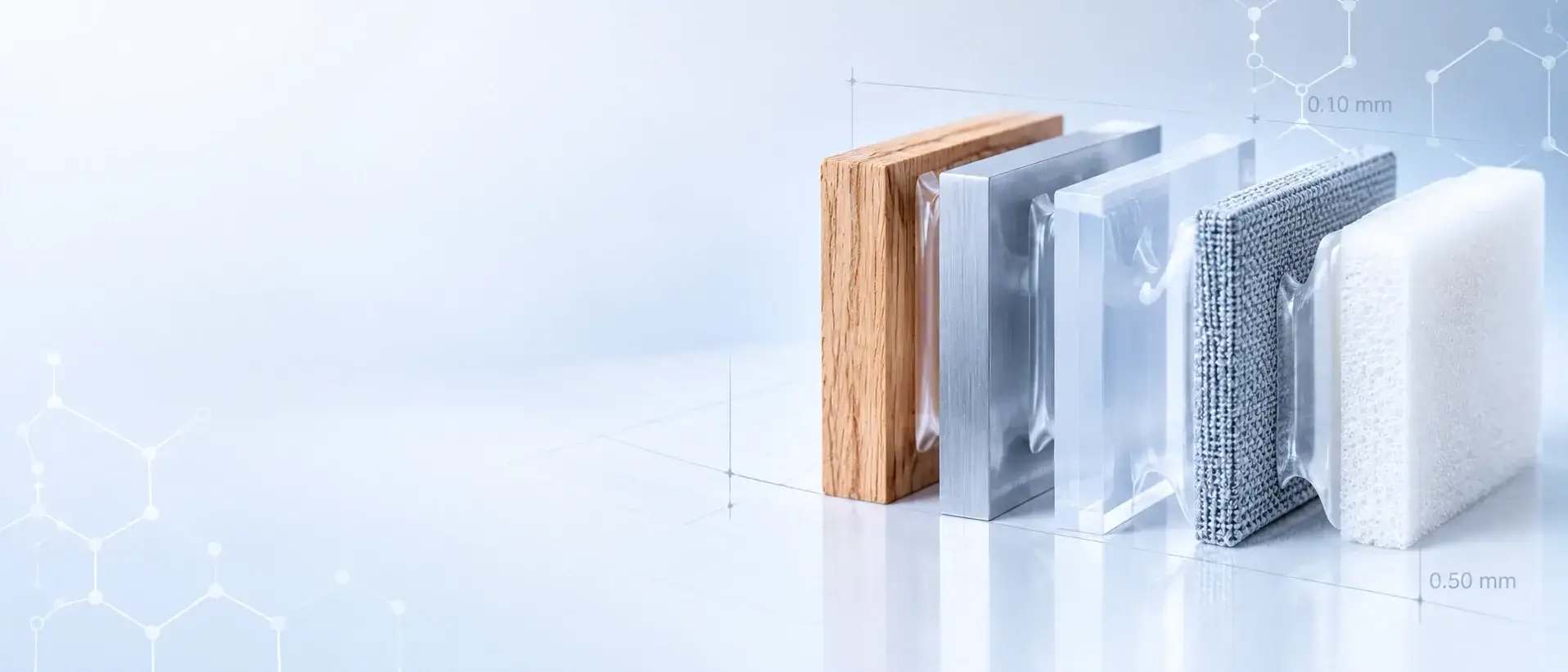
- Compatible with wood, laminate, HPL, rubber, leather, fabric, and metal
- Available in brush-grade and spray-grade viscosities
Technical Specifications
| Parameter | Value |
|---|---|
| Base Polymer | Chloroprene Rubber (CR / Neoprene) |
| Solid Content | 20-25% |
| Viscosity | 2,500-4,500 mPa·s (brush grade) / 800-1,500 mPa·s (spray grade) |
| Density | 0.85-0.90 g/cm³ |
| Open Time | 10-20 minutes |
| Bond Strength (Peel) | ≥3.0 N/mm (wood-to-laminate) |
| Heat Resistance | -20°C to +120°C |
| Solvent System | Toluene-free formulation on request — solvents listed on the grade SDS |
| Flash Point | ≤-4°C |
| Color | Yellow / Amber |
| Shelf Life | 12 months (sealed, 5-35°C) |
| Packaging | 0.5L, 1L, 3L, 15L tin cans; 200L drums |
Indicative values for the series. Figures move with the grade, the substrate pair, coat weight and cure conditions, so treat them as a basis for comparison rather than a specification — the technical data sheet for the grade you are supplied states the values that apply to it, and the conditions they were measured under.
Applications
- Furniture manufacturing — laminate and HPL bonding to wood substrates
- Footwear assembly — upper-to-sole bonding and lasting
- Automotive interior — headliner, carpet, and trim bonding
- Leather goods — bag, belt, and accessory production
- Construction — decorative panel and insulation board installation
See how neoprene contact adhesive serves specific sectors: Furniture & Woodworking, Footwear & Leather, Automotive.
Brush Grade or Spray Grade?
The same chemistry is made at two viscosities because the application method decides what the adhesive has to do. They are not interchangeable by thinning.
| Brush / roller grade | Spray grade | |
|---|---|---|
| Viscosity (this grade) | 2,500–4,500 mPa·s | 800–1,500 mPa·s |
| Applied with | Brush, roller or notched spreader | Spray gun from a pressure pot or pump |
| Coat weight control | Depends on the operator; tends to heavier coats | Set by gun and pressure; thinner, more even coats |
| Waste | Little | Overspray loss; needs extraction |
| Drying | Thicker film dries more slowly | Thin film flashes off faster |
| Best for | Edges, small parts, workshops | Large panels and production lines |
Thinning a brush grade to make it spray lowers the solids, changes coverage and adds solvent — and with it VOC. If you need to spray, ask for the spray grade. Viscosity figures are only comparable at the same temperature and measuring method.
What It Bonds, and What Needs Extra Preparation
| Substrate | What to do |
|---|---|
| Wood, MDF, plywood, HPL back | Coat both surfaces; seal-coat very porous boards first |
| Genuine leather | Buff the grain to open the surface; keep the coat thin to avoid strike-through |
| PVC-coated fabric, synthetic leather | Test first — plasticiser migrating out of PVC can soften the bond over months |
| Natural rubber, SBR, neoprene rubber | Roughen and wipe clean; bonds well |
| EPDM and silicone rubber | Bonds poorly as supplied — needs a primer or a different adhesive |
| Steel, aluminium | Degrease and abrade; a primer where the TDS calls for one. Suits flexible-to-metal bonds, not structural joints |
| PE, PP, PTFE | Will not bond without surface treatment |
| Rigid PVC, ABS | Test on the actual part; the solvent can mark or stress some plastics |
| EPS and XPS foam | Do not use — the solvent attacks polystyrene. Use a foam-safe spray adhesive |
More detail: rubber-to-metal bonding, leather goods, foam spray adhesive.
Available Packaging
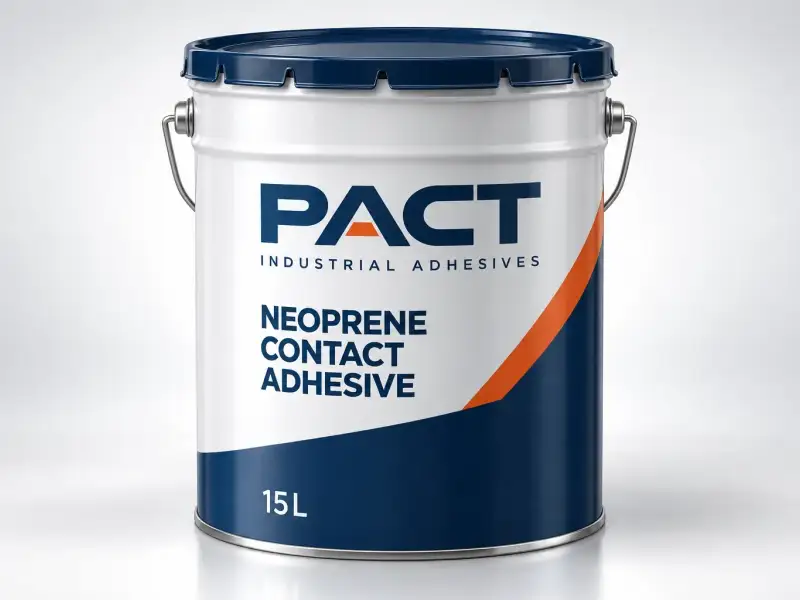
Neoprene contact adhesive is supplied in 0.5L, 1L, 3L, and 15L tin cans for workshop and retail distribution, as well as 200L steel drums for bulk industrial consumption. Custom packaging sizes, private label printing, and OEM branding are available for orders meeting minimum quantity requirements. All containers are sealed with tamper-evident closures to ensure product integrity during shipping and storage.
Certifications & Compliance
Quick Specs
- Base Polymer
- CR (Neoprene)
- Bond Strength
- ≥3.0 N/mm (wood-to-laminate)
- Heat Resistance
- -20°C to +120°C
- Open Time
- 10-20 minutes
- Solid Content
- 20-25%
Get a Quote
Request pricing, samples, or technical data sheets for Neoprene Contact Adhesive.
Request a QuoteWater-based option
Could this job run water-based?
For laminate-to-board work the deciding question is whether one side is porous. Board is, the laminate face is not, and that pairing is what a water-based contact adhesive is built for. Two non-porous surfaces are where it struggles.
- Drying time before assembly is longer
- The film has to be dry before the surfaces meet, and humid air extends that. On a hand-laid bench this shows up as a slower cycle rather than a failure.
- Heat resistance is re-tested, not assumed
- Where panels see heat in service — near a cooktop, in a hot container, on a sunlit facade — the bond has to be re-qualified on your own board and laminate.
- Press or no press changes the answer
- With a press the requirement is different from a J-roller bench. Tell us which you run before comparing grades; it decides which candidates are worth a trial.
Frequently Asked Questions
What makes neoprene contact adhesive different from SBS?
Is your neoprene adhesive toluene-free?
What surfaces can neoprene contact adhesive bond?
How should neoprene contact adhesive be applied?
What is the coverage rate of neoprene contact adhesive?
Ready to Order Neoprene Contact Adhesive?
Contact our sales team for factory-direct pricing, bulk order discounts, and free product samples.