
PU Foam Manufacturer — Polyurethane Foam Sealant from China
Expanding polyurethane foam sealants for gap filling, insulation, and construction sealing. Available in one-component, fire-rated, and application-specific formulations.
What Is PU Foam Sealant?
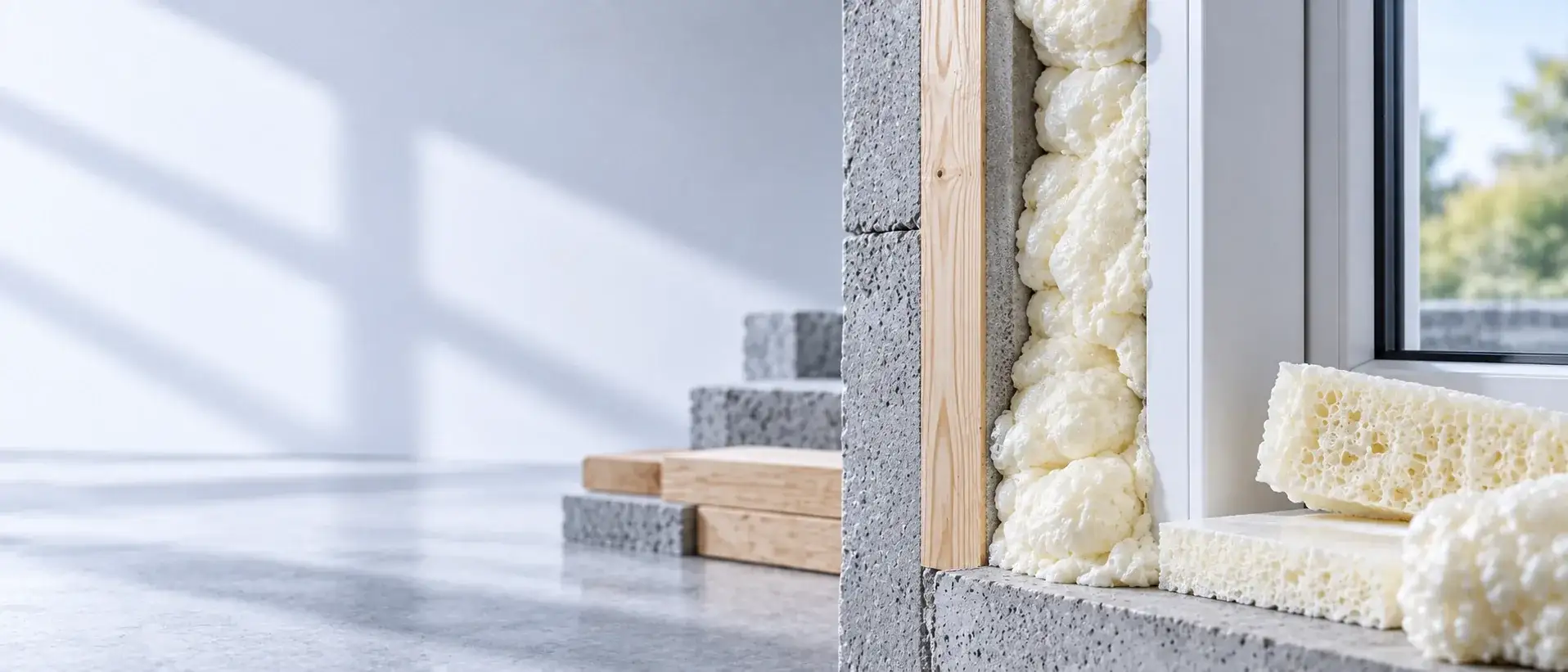
PU foam (polyurethane foam sealant) is a one-component, moisture-curing expanding foam dispensed from a pressurized aerosol can. When the foam exits the can, it reacts with atmospheric moisture and expands to fill gaps, cavities, and joints in building structures. The foam cures into a rigid or semi-rigid cellular structure that provides sealing against air infiltration, water penetration, and sound transmission, while also delivering meaningful thermal insulation value. PU foam has become an indispensable product on construction sites worldwide — from residential door and window installation to commercial building envelope sealing.
The chemistry behind PU foam is straightforward: a prepolymer based on MDI (methylene diphenyl diisocyanate) reacts with moisture in the air to form polyurethane polymer chains. This reaction generates carbon dioxide gas, which creates the foam's cellular structure and causes expansion. A propellant gas (typically HFO or DME, both CFC-free) provides the pressure to expel the foam from the can. The combination of chemical expansion and propellant pressure determines the foam's expansion ratio, cell structure, and final density — all of which are carefully formulated for different applications.
PU Foam Types and Formulations
General-Purpose Expanding PU Foam
Standard PU foam is designed for general gap filling and insulation tasks. A bead keeps growing about 2-3 times after it leaves the nozzle, it adheres to most construction substrates (concrete, brick, wood, metal, PVC), and cures to a semi-rigid foam with good insulation and sealing properties. Available in straw-type cans (with a plastic application tube) for consumer and light-commercial use, and gun-type cans that attach to professional PU foam applicator guns for precise dispensing and volume control. General-purpose foam is the workhorse product for construction contractors, handling everything from pipe penetration sealing to irregular cavity filling.
Door and Window PU Foam (Low Expansion)
Door and window foam is specifically formulated with controlled low expansion (approximately 1.5x volume) and carefully calibrated post-expansion pressure. Standard expanding foam can generate enough pressure during expansion to warp or bow window and door frames — a common complaint from installers using inappropriate foam products. Low-expansion door and window foam solves this problem by expanding gently to fill the gap between the frame and the rough opening without exerting damaging force on the frame. This formulation is essential for professional window and door installation, where frame alignment and smooth operation of opening hardware must be preserved.
B1 Flame-Retardant PU Foam
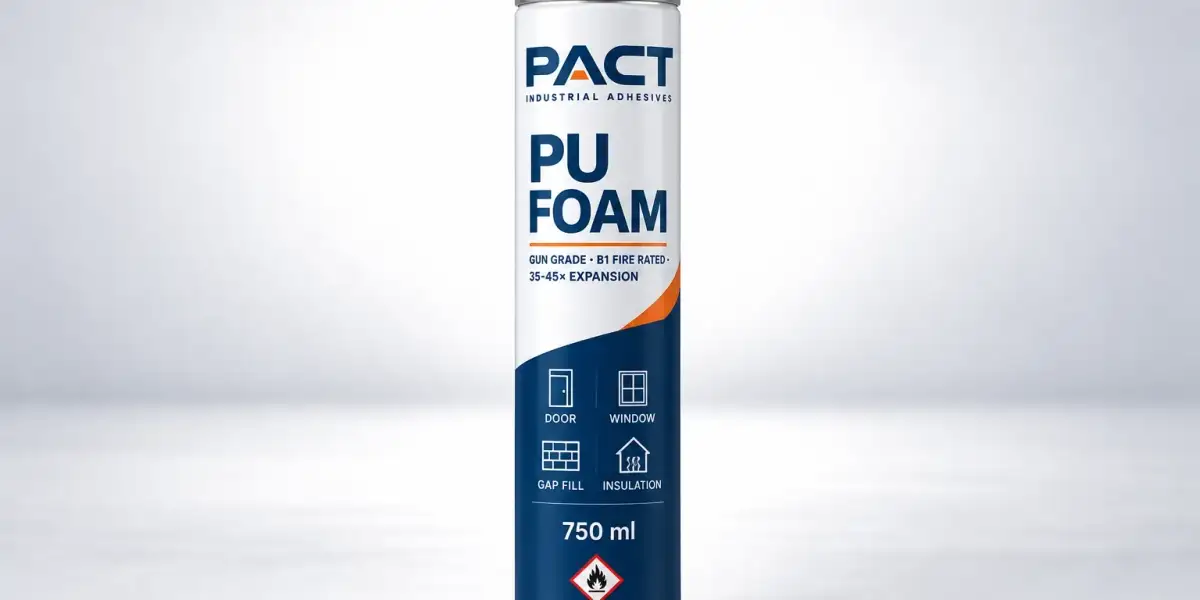
B1 PU foam contains flame-retardant additives so the cured foam is hard to ignite and does not keep burning once the flame is removed. B1 is a reaction-to-fire class under DIN 4102-1: it describes how the foam material behaves, and PACT's B1 grade is tested to that classification with a report that names the grade.
It is not a fire-resistance rating. Firestops around pipe and cable penetrations and joints in fire compartment walls are rated in minutes, and that rating belongs to a complete system tested with a stated joint width, depth, backing and wall construction — not to a foam's material class. A B1 foam used in such a joint does not make the joint fire-rated. Where a specification calls for a firestop or a fire-rated joint, send us the clause and we will tell you whether we hold a matching system test report rather than offering the B1 report in its place.
Choosing a Grade: The Five Questions That Decide It
| Question | Why it matters | What to tell us |
|---|---|---|
| Gun or straw? | A gun meters the bead and keeps a part-used can sealed between jobs. A straw can is for occasional, single-session use and wastes more of a part-used can. | Cans used per day and whether installers already own foam guns |
| Door and window, or general gap? | General-purpose foam grows more after dispensing, and the pressure can bow a PVC or aluminium frame. Low-expansion foam is formulated to fill without that pressure. | Frame material and typical gap width |
| Yield or post-expansion? | Yield is cured foam volume against liquid volume; post-expansion is growth after the nozzle. Datasheets call both "expansion", and yield is measured on free-rise foam, so it overstates what a narrow joint receives. | Which figure your current supplier quotes, and under what test conditions |
| How cold is the site? | Cold cans and substrates reduce yield and slow the cure. The storage temperature on a TDS is a separate limit from the application window, and meeting one says nothing about the other. | Lowest temperature during installation, and whether that calls for a winter grade |
| Is there a fire clause? | A material class such as B1 and a fire-resistance rating for a joint are different requirements, answered by different test reports. | The clause from the project specification, word for word |
Troubleshooting PU Foam on Site
Most foam complaints trace back to moisture, temperature or fill depth rather than to the foam in the can. Check these before changing product:
| Symptom | Likely cause | Check first |
|---|---|---|
| Foam shrinks back or collapses | Too little moisture to cure in dry air, or a cold can | Mist the joint surfaces before foaming in dry conditions; bring cans to room temperature first |
| Large voids inside the cured bead | A deep gap filled in one pass, so moisture cannot reach the core | Fill wide or deep gaps in layers, misting between them |
| Frame bowed after installation | General-purpose foam in a frame gap, or the gap overfilled | Use low-expansion door and window foam, and fill only to the depth its TDS gives — about half the gap for general-purpose foam, more for low-expansion grades |
| Foam peels off the substrate | Dust, release oil or frost on the surface, or a substrate foam does not bond to | Clean and dry the surface; PU foam does not bond to PE, PP, PTFE or silicone |
| Cured foam yellows and crumbles | UV exposure — PU foam is not UV-stable | Trim, then cover, paint or seal exposed foam |
| Can sputters or dispenses unevenly | Can too cold, not shaken, or cured foam in the gun or valve | Shake as the can directs; clean the gun with foam cleaner before foam cures inside it |
When you ask for a quote or sample, tell us the can type and size, the joint type and width, the lowest site temperature, any fire clause in the specification, and the problem you have with your current foam if there is one. Storage limits for shipping foam through hot climates are covered in our storage and shelf life guide.
Primary Construction Applications
- —Door and window installation: Filling and insulating the gap between door/window frames and the surrounding wall structure. This is the single largest application for PU foam globally. Proper foam application provides thermal insulation, air sealing, and structural support for the installed frame.
- —Gap filling and cavity sealing: Sealing irregular openings, gaps around pipes and conduits, spaces behind electrical boxes, and joints between structural elements. The expanding nature of PU foam allows it to fill complex geometries that rigid sealants cannot reach.
- —Thermal insulation: PU foam's closed-cell structure provides thermal conductivity of approximately 0.035-0.040 W/mK, making it an effective insulating material for small-area applications. It fills thermal bridge gaps in wall assemblies and insulates penetrations through the building envelope.
- —Sound insulation: PU foam dampens airborne noise transmission through gaps and joints. While not a substitute for dedicated acoustic materials, foam sealing of air leaks significantly reduces sound flanking paths in wall and floor assemblies.
- —Adhesive bonding: PU foam also functions as a bonding adhesive for lightweight insulation panels, fixing decorative elements, and securing conduit runs. The expanding foam fills uneven surfaces and creates a strong mechanical bond after curing.
PACT PU Foam Production
Our PU foam production facility in Guangzhou features high-speed aerosol filling lines with capacity exceeding 80,000 cans per day. The production process includes prepolymer synthesis, propellant charging, and quality verification at every stage. Each production batch is tested for expansion ratio, density, adhesion to standard substrates, dimensional stability, and fire performance (for fire-rated grades). We manufacture PU foam in 300ml, 500ml, and 750ml can sizes, in both straw-type and gun-type applicator formats. Full OEM and private label services include custom can design, label printing, valve and actuator selection, and branded outer carton packaging. Our PU foam is exported to construction markets across Southeast Asia, Africa, the Middle East, and Latin America, where our formulations are optimized for tropical and high-humidity curing conditions.
Frequently Asked Questions
What types of PU foam do you manufacture?
What is the expansion rate of your PU foam?
Is your PU foam CFC-free?
What packaging sizes are available for PU foam?
PU foam — specification and shipping
- PU foam or silicone sealant for this gap?
Expansion and insulation against movement accommodation — the wrong pick fails in a season.
- Seal and finish the joint after foaming
Cured foam needs protecting from UV; a sealant bead is the normal finish.
- Fix the frame as well as fill the gap
Panel and trim adhesives for the same installation.
- Door and window installation requirements
Fire grade, expansion rate and cure time as installers actually specify them.
- Shipping aerosols and foam by sea
Aerosol cans travel as dangerous goods — what that changes about your container.
- Review our certifications and test reports
ISO 9001, ISO 14001, REACH statements and SGS reports, and what each one covers.
- Put your own brand on it — OEM and ODM
Custom labels, cartons and formulation adjustments from our existing lines.
- Read the ordering and shipping FAQ
MOQ, lead time, payment terms, samples and documentation in one place.
- Storage, shelf life and what heat does to it
Why a container crossing the tropics at 60-70°C is the hardest storage condition your adhesive will see.
- Send a specification and get a quote
Substrate, volume and destination market are enough for us to price it.
Need a Custom PU Foam Formulation?
From standard gap filling to fire-rated and low-expansion formulations, our technical team can develop PU foam tailored to your market requirements and climate conditions.